


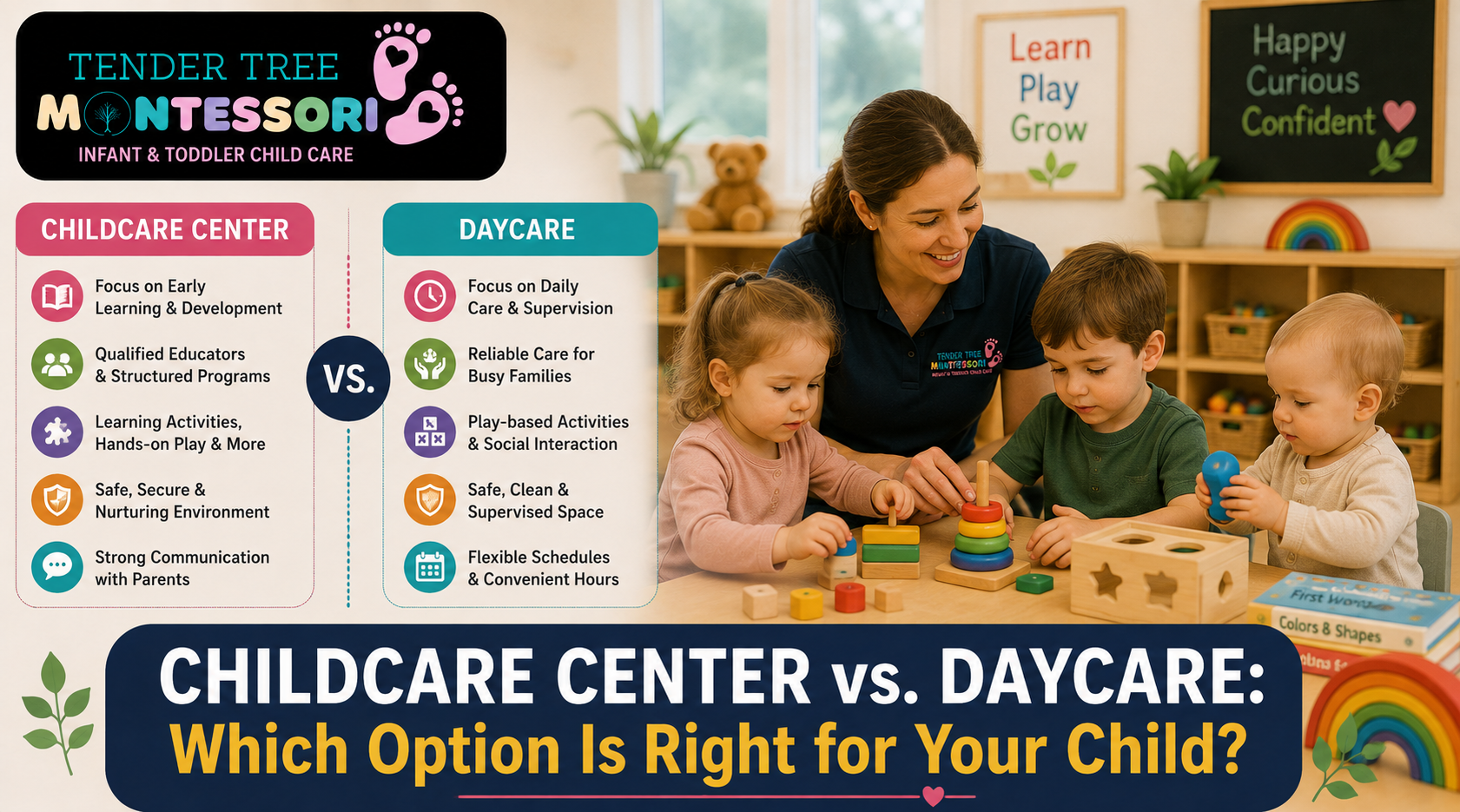
Childcare Center vs. Daycare: Which Option Is Right for Your Child?
Childcare Center vs. Daycare: Which Option Is Right for Your Child?
Choosing care for your child is one of the most important decisions a parent can make.
When families search online for a childcare centre near me or daycare near me, they often see many different programs. However, the terms childcare and daycare can be used differently from one provider to another.
Both types of programs may offer supervision, routines, meals, play, and social interaction. However, their educational approach, daily structure, age groups, and services can vary significantly.
For parents in Fort McMurray, the goal should not simply be to find the closest available space. Instead, look for an environment where your child feels safe, supported, respected, and encouraged to learn.
Understanding what to compare can make the decision much easier.
What Is a Childcare Centre?
A childcare centre provides care and supervision for children while parents or guardians are working, studying, or managing other responsibilities.
Many childcare centres also incorporate early learning into the daily routine.
Children may participate in:
- Creative activities
- Storytelling
- Music and movement
- Practical activities
- Sensory exploration
- Outdoor play
- Social activities
- Age-appropriate learning experiences
The exact program varies by provider.
Childcare Can Support Whole-Child Development
Quality childcare can support more than academic preparation.
Children develop through everyday experiences. They learn how to communicate, cooperate, make choices, solve problems, manage emotions, and become more independent.
Expert insight: Early childhood programs are most beneficial when they address multiple areas of development, including social, emotional, physical, language, and cognitive growth.
What Is Daycare?
Daycare generally refers to a service that provides regular care for children during the day.
The word “daycare” is commonly used by parents when searching for programs that fit their work and family schedules.
A daycare may include:
- Supervised play
- Meals and snacks
- Rest periods
- Indoor activities
- Outdoor activities
- Group activities
- Quiet time
- Basic learning experiences
However, daycare is not a single standardized model. One daycare may have a highly structured educational program, while another may focus primarily on care and routine.
Therefore, parents should evaluate the actual program instead of relying only on the name.
Childcare Centre vs. Daycare: What Is the Difference?
The difference between childcare and daycare is often less important than the individual program.
A childcare centre may emphasize development and early learning. A daycare may also provide these experiences.
Instead of asking only, “Is this childcare or daycare?” ask:
“What will my child experience here every day?”
Compare the Following Factors
| Factor | Childcare Centre | Daycare |
| Supervision | Usually provided | Usually provided |
| Daily routines | Common | Common |
| Early learning | Often emphasized | May be included |
| Play activities | Common | Common |
| Outdoor activities | Depends on program | Depends on program |
| Meals/snacks | Depends on provider | Depends on provider |
| Age groups | Varies | Varies |
| Schedule | Depends on provider | Depends on provider |
| Educational philosophy | Varies | Varies |
The most important factor is the quality and suitability of the specific program.
1. Consider Your Child’s Age
Your child’s age should influence the type of program you choose.
Infants need close attention, predictable routines, responsive care, and opportunities for sensory and motor development.
Toddlers need opportunities to explore, communicate, move, and develop independence.
Preschool-aged children can benefit from more complex social interaction, creative activities, early literacy experiences, problem-solving, and practical learning.
Ask About Age-Appropriate Activities
When visiting a childcare centre near me, ask:
- What activities are offered to children my child’s age?
- How are activities adapted to developmental abilities?
- How much free play is included?
- How much outdoor time is provided?
- How do educators encourage independence?
The program should match the developmental stage of your child.
2. Look at the Learning Environment
The physical environment can strongly influence a child’s daily experience.
A good learning space should be clean, organized, welcoming, and designed with children’s needs in mind.
Look for:
- Age-appropriate furniture
- Safe play areas
- Accessible learning materials
- Reading areas
- Creative spaces
- Comfortable rest areas
- Suitable indoor activity areas
- Secure entrances and exits
During your visit, observe whether children appear comfortable and engaged.
Also watch how educators communicate with children.
Respectful, calm interactions can tell you a lot about the program’s culture.
3. Ask About Educators
Educators play a central role in your child’s experience.
Ask about their qualifications, experience, training, and approach to working with children.
Questions Worth Asking
- What qualifications do educators have?
- How does the centre support staff training?
- How long have educators worked with young children?
- How does the centre manage staff changes?
- Who supervises children throughout the day?
Expert insight: Consistent and responsive adult-child relationships are important components of high-quality early childhood experiences.
Parents should feel comfortable asking detailed questions about staffing.
4. Check Safety and Security
Safety should be a priority when comparing childcare Fort McMurray options.
A childcare provider should have clear procedures for protecting children during regular activities and emergencies.
Ask About:
- Secure entry procedures
- Visitor access
- Emergency plans
- Fire safety
- First-aid procedures
- Child supervision
- Playground safety
- Medication procedures
- Allergy management
- Authorized pickup procedures
Ask how the centre handles unexpected situations.
A professional provider should explain its policies clearly.
5. Evaluate the Daily Schedule
Children often benefit from predictable routines.
A good schedule provides structure without making the entire day rigid.
For example, a typical day may include:
- Arrival and welcome time
- Free-choice activities
- Group learning
- Creative play
- Meals or snacks
- Outdoor activities
- Quiet or rest time
- Individual exploration
- Additional group activities
- Departure routine
The exact schedule will depend on the child’s age and program.
Why Flexibility Matters
Young children do not always follow a perfect schedule.
A child may need additional rest, emotional support, or time to finish an activity.
Look for a program that provides structure while responding appropriately to individual children.
6. Compare Play and Early Learning
Parents sometimes worry that childcare is only about keeping children occupied.
Quality early learning should be intentional.
Children can learn through:
- Building
- Sorting
- Painting
- Reading
- Singing
- Pretend play
- Practical tasks
- Puzzles
- Nature exploration
- Group discussions
These activities can build language, motor skills, creativity, concentration, and problem-solving abilities.
7. Consider Outdoor Activities
Outdoor play gives children opportunities to move, explore, and interact with their surroundings.
When comparing daycare near me options, ask how often children go outside and how outdoor activities are managed during different seasons.
Ask:
- Is there a dedicated outdoor play area?
- How frequently do children go outside?
- How are outdoor activities adapted for weather?
- What safety measures are used?
- Are children encouraged to explore nature?
For families in Fort McMurray, understanding the program’s seasonal outdoor policies can be especially useful.
8. Think About Meals and Nutrition
If meals and snacks are included, ask what the program provides.
You should understand how the centre manages allergies and dietary restrictions.
Important Questions
- Are meals included?
- Are snacks provided?
- What type of food is served?
- How are food allergies handled?
- Can parents provide food?
- How are dietary restrictions communicated to staff?
Clear procedures help parents feel more confident about their child’s daily routine.
9. Evaluate Parent Communication
Communication between educators and parents is essential.
Parents should know how their child is doing and how to raise concerns.
A provider may communicate through:
- Daily conversations
- Written updates
- Digital platforms
- Parent meetings
- Progress discussions
- Phone calls
- Emails
Ask How Information Is Shared
Find out how you will receive updates about meals, naps, activities, behaviour, development, and important incidents.
Also ask who you should contact if you have a concern.
Strong communication helps create a partnership between families and educators.
10. Compare Hours and Convenience
A program can be excellent but still unsuitable if its hours do not fit your family’s schedule.
Before choosing a daycare Fort McMurray provider, check:
- Opening hours
- Closing hours
- Drop-off procedures
- Pickup policies
- Holiday closures
- Vacation policies
- Late pickup policies
- Transportation options
- Waitlist requirements
Don’t Choose Based Only on Location
A nearby daycare near me may save travel time. However, convenience should not be your only consideration.
Compare location with safety, educators, learning experiences, communication, schedule, and your child’s comfort.
11. Understand Fees and Enrollment
Cost is an important part of any childcare decision.
However, parents should compare the total value rather than choosing solely based on the lowest fee.
Ask what the advertised fee includes.
Possible Additional Costs
Depending on the provider, families may encounter charges for:
- Registration
- Meals
- Special activities
- Supplies
- Extended hours
- Field trips
- Late pickup
Ask for a clear explanation of fees before completing enrollment.
12. Visit Before You Decide
Online research is useful, but an in-person visit can reveal important details.
When you visit, pay attention to the atmosphere.
Observe the Children
Do they appear:
- Comfortable?
- Engaged?
- Curious?
- Active?
- Supported?
Observe the Educators
Do educators:
- Listen to children?
- Speak respectfully?
- Provide guidance?
- Encourage independence?
- Respond calmly?
These observations can help you understand what daily life may feel like for your child.
Choosing Childcare in Fort McMurray
Families searching for childcare Fort McMurray options should consider both their practical requirements and their child’s developmental needs.
Fort McMurray families have different work schedules, transportation needs, and childcare preferences. Some parents may prioritize extended hours. Others may place greater importance on Montessori education, early learning, outdoor activities, or a smaller classroom environment.
There is no single program that is perfect for every child.
The right choice is the program that combines safety, caring educators, developmentally appropriate learning, family communication, and a schedule that works for you.
Create a Shortlist
Start with three to five programs.
Then compare them using the same questions.
This makes it easier to identify meaningful differences between providers.
Childcare Centre Near Me: A Parent’s Comparison Checklist
Before choosing a provider, use this checklist:
Safety
- Secure facility
- Clear emergency procedures
- Appropriate supervision
- First-aid procedures
- Safe indoor and outdoor spaces
Learning
- Age-appropriate activities
- Play-based learning
- Creative activities
- Reading and language development
- Opportunities for independence
Educators
- Qualified staff
- Experienced educators
- Respectful communication
- Consistent staffing
- Ongoing professional development
Family Needs
- Convenient location
- Suitable hours
- Clear fees
- Availability
- Flexible policies where appropriate
Parent Partnership
- Regular updates
- Clear communication
- Easy contact with educators
- Transparent policies
- Opportunities to discuss development
Frequently Asked Questions
What is the difference between childcare and daycare?
Childcare and daycare can both provide supervision, routines, play, and learning opportunities for young children. The main difference is often how individual providers describe their services rather than a universal distinction. Parents should compare each program’s educational approach, staffing, safety practices, schedule, activities, and developmental support instead of relying on the label alone.
Why should I visit a childcare centre before enrolling?
Visiting allows parents to evaluate the environment, educators, cleanliness, safety procedures, classroom activities, and overall atmosphere. You can observe how staff interact with children and ask questions about daily routines. A visit also helps determine whether your child appears comfortable and whether the program matches your family’s expectations.
How do I choose a daycare in Fort McMurray?
Start by identifying your child’s needs and your family’s schedule. Then compare several daycare Fort McMurray options based on educator qualifications, safety, learning activities, outdoor play, communication, hours, fees, and location. Visit your preferred programs and ask consistent questions before making an enrollment decision.
When should I start looking for childcare near me?
Start your search as early as possible, particularly if you need care by a specific date. Some programs may have limited spaces or waiting lists. Early research gives you time to visit multiple providers, compare programs, understand enrollment requirements, and choose an environment that suits your child’s needs.
Who should I speak with when evaluating a childcare program?
Speak with the program director or administrator and, when possible, meet the educators who will work with your child. Ask about daily routines, learning activities, safety, staffing, communication, meals, outdoor play, and behaviour guidance. Their answers can help you understand whether the program is a good fit.
Conclusion
Choosing between a childcare centre and daycare is not simply about picking one label over another. The quality and suitability of the individual program matter most.
When searching for a childcare centre near me, look at the complete experience your child will receive. Consider safety, educators, learning opportunities, play, routines, outdoor activities, communication, hours, and cost.
Families looking for childcare Fort McMurray or daycare Fort McMurray options should take time to visit programs and ask questions before enrolling.
Tender Tree Montessori is committed to creating a caring environment where children can learn, explore, develop independence, and build positive relationships.
If you are looking for an early learning and childcare option in Fort McMurray, contact Tender Tree Montessori at +1 (780) 381-5358 to learn more about the program and discuss your child’s needs.