


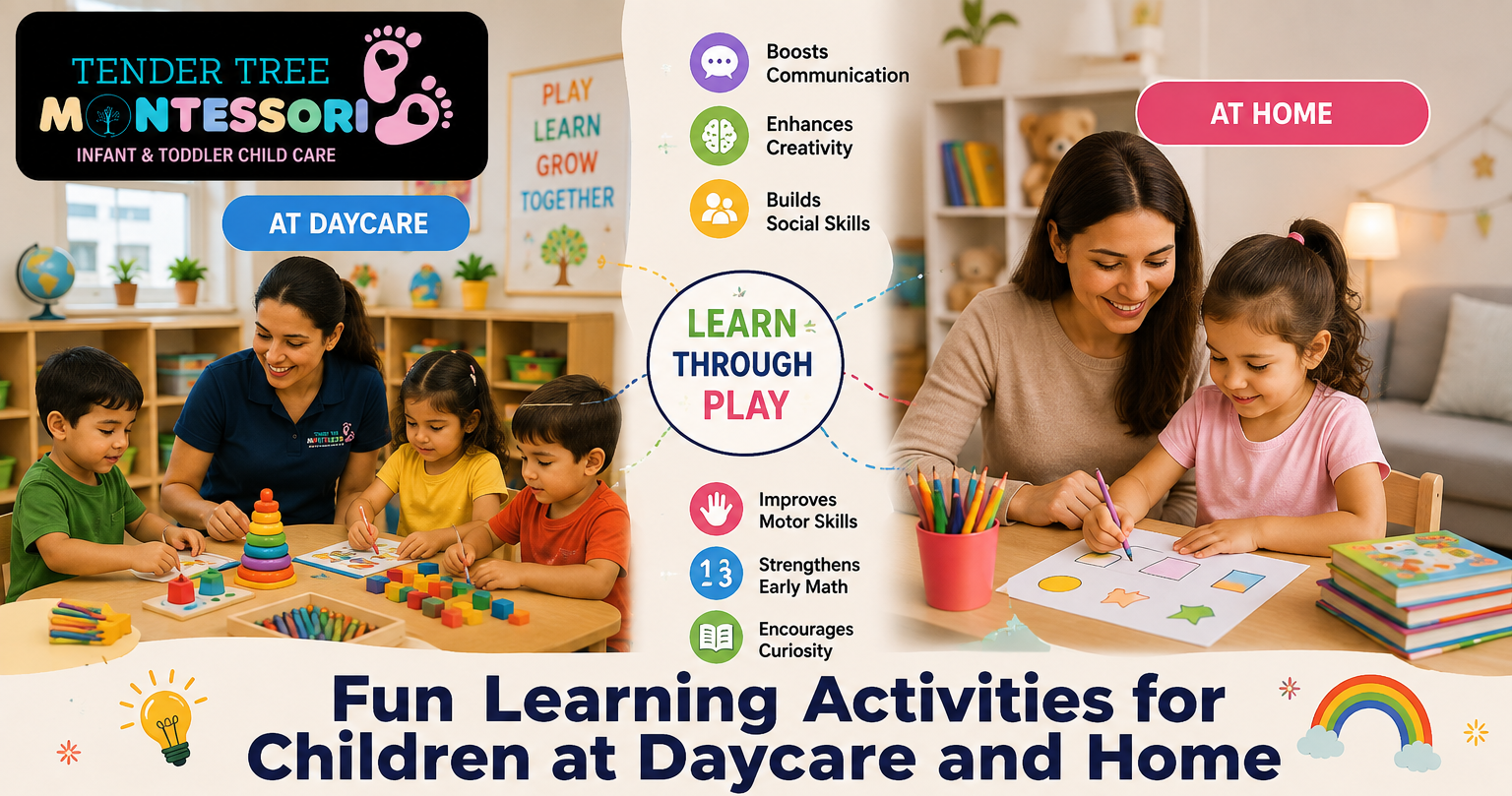
Fun Learning Activities for Children at Daycare and Home
Fun Learning Activities for Children at Daycare and Home
Children learn through almost everything they do. A simple story can introduce new vocabulary. Building with blocks can develop spatial awareness. Sorting toys can teach early math. Helping prepare a snack can introduce counting, sequencing, and practical life skills.
Learning does not have to feel like schoolwork. In early childhood, children often learn best when they can move, explore, create, ask questions, and solve problems.
This makes carefully planned activities an important part of quality Childcare Fort McMurray programs. Educators can create experiences that support a child’s development while allowing children to enjoy the process.
Parents can also continue these learning opportunities at home. The key is to keep activities age-appropriate, interactive, and enjoyable.
For families looking for a Daycare in Fort McMurray, understanding how learning activities support development can also help them evaluate different childcare environments.
Why Learning Through Play Is Important
Play is more than entertainment for young children. It provides opportunities to practice language, movement, social interaction, creativity, memory, attention, and problem-solving.
According to the American Academy of Pediatrics, play supports healthy development and can strengthen language, social-emotional, cognitive, and physical skills.
A strong Daycare Centre Fort McMurray should therefore provide children with a balance of structured learning and independent exploration.
Play Makes Learning Meaningful
Children are more likely to engage with a concept when they can experience it directly.
For example, learning about numbers becomes more meaningful when a child counts real blocks. Learning vocabulary becomes more natural when children discuss objects during a nature walk.
This approach connects learning with real experiences.
Repetition Builds Confidence
Young children often need to repeat activities before mastering a new skill.
A child might build the same type of block tower several times. Another child may want to hear the same story repeatedly.
Repetition is not wasted time. It gives children opportunities to practice, make adjustments, and build confidence.
Fun Learning Activities for Daycare
A quality daycare can provide a wide range of activities that support different areas of development.
1. Storytelling and Picture Books
Reading aloud is one of the simplest ways to support early literacy.
Teachers can choose age-appropriate books and encourage children to participate by asking questions.
For example:
- What do you see in the picture?
- What do you think will happen next?
- How does the character feel?
- Can you find the red object?
- Can you remember what happened earlier?
These questions encourage children to listen, understand, remember, and communicate.
Make Storytelling Interactive
Educators can use puppets, picture cards, props, and simple acting to make stories more engaging.
Children can also retell a story in their own words. This activity supports vocabulary, memory, sequencing, and communication.
2. Counting Games
Counting can become a fun group activity.
Teachers can ask children to count blocks, toys, buttons, classroom objects, or steps.
For younger children, educators can begin with small quantities. Older preschoolers can gradually work with larger groups and simple comparisons.
For example:
“Which group has more blocks?”
“Can you give me five blocks?”
“How many children are sitting at the table?”
These questions help children connect number words with actual quantities.
Make Counting Hands-On
Children can count objects while moving them into groups. This combines physical movement with mathematical thinking.
Hands-on counting is especially useful because children can see and touch the quantities they are learning about.
3. Sorting and Matching Activities
Sorting games encourage children to identify similarities and differences.
Give children a collection of safe objects and ask them to organize the items according to:
- Colour
- Shape
- Size
- Texture
- Type
- Number
For example, children can place all red objects in one basket and blue objects in another.
They can then explain why they grouped the objects together.
This activity develops classification, observation, vocabulary, and early mathematical reasoning.
4. Building With Blocks
Blocks are valuable learning materials because they support several areas of development at once.
Children can:
- Build towers
- Create bridges
- Compare heights
- Count blocks
- Identify shapes
- Design structures
- Solve balance problems
- Work together
A teacher can extend the activity by asking questions such as, “How can you make your tower taller?” or “What happens if you put the larger block at the bottom?”
These questions encourage children to think about size, balance, cause and effect, and problem-solving.
5. Music, Songs, and Rhymes
Songs are excellent tools for early learning.
Children can learn through:
- Alphabet songs
- Counting songs
- Rhyming games
- Action songs
- Clapping games
- Rhythm activities
Songs can help children remember words, sequences, sounds, and concepts.
Movement also adds a physical component to learning.
According to early childhood education research, music and movement activities can support language, social interaction, memory, and motor development.
Fun Learning Activities to Try at Home
Learning does not stop when children leave daycare. Parents can reinforce important skills with simple activities that require little preparation.
6. Create a Home Reading Routine
Set aside time each day for reading.
The routine does not need to be long. Even a short, focused reading session can provide valuable opportunities for conversation and vocabulary development.
Ask your child questions about the pictures. Encourage them to predict what happens next.
You can also let your child choose the book.
Turn Reading Into Conversation
Instead of simply reading every word, pause occasionally and discuss the story.
Ask:
“What do you notice?”
“Where is the character going?”
“What would you do?”
“What do you think happens next?”
These questions encourage children to express ideas and make connections.
7. Number Hunt Around the House
Turn numbers into a simple treasure hunt.
Ask your child to find numbers around the home. Look for numbers on clocks, books, packaging, calendars, measuring cups, or household items.
You can then ask the child to identify the numbers or put them in order.
This activity helps children recognize that numbers exist in everyday life.
8. Cook and Count Together
Cooking can become a practical math lesson.
Children can help count ingredients, compare quantities, identify shapes, and follow a sequence.
For example:
- Count three pieces of fruit.
- Add two cups of an ingredient.
- Stir the mixture.
- Place the items in order.
- Talk about what happens next.
Always supervise children closely and use age-appropriate, safe tasks.
Cooking can introduce counting, measurement, sequencing, vocabulary, and practical life skills at the same time.
9. Nature Scavenger Hunt
Outdoor exploration creates natural learning opportunities.
Take your child outside and make a simple scavenger hunt.
Ask them to find:
- A small leaf
- A large leaf
- A round object
- Something green
- A smooth object
- A rough object
- Three different types of plants
The activity encourages observation and descriptive language.
It also gives children opportunities to move and explore their surroundings.
10. DIY Shape Hunt
Teach shapes using objects around the home.
Ask your child to find:
- Circles
- Squares
- Rectangles
- Triangles
A plate might represent a circle. A window might look like a rectangle.
This activity helps children connect abstract shape names with objects they encounter every day.
11. Create a Simple Sensory Bin
A sensory activity can involve safe materials such as dry pasta, large child-safe objects, scoops, containers, or other age-appropriate materials.
Children can explore texture, quantity, size, and movement.
For example, ask:
“Which container holds more?”
“Can you find the large object?”
“How many pieces did you scoop?”
Always choose materials appropriate for the child’s age and supervise closely, especially where small objects could present a choking risk.
Learning Activities That Build Social Skills
Academic learning is only one part of early childhood development.
Children also need opportunities to communicate, cooperate, share, listen, and manage emotions.
Cooperative Games
Simple group activities can encourage children to work together.
Examples include:
- Building one large block structure
- Completing a group puzzle
- Passing a ball
- Creating a classroom story
- Working together on an art project
These activities encourage communication and teamwork.
Role-Playing
Pretend play allows children to explore real-life situations.
They might pretend to be:
- Doctors
- Teachers
- Chefs
- Shopkeepers
- Parents
- Construction workers
Role-playing develops vocabulary, imagination, social understanding, and communication.
Creative Activities for Preschool Children
Creativity allows children to express ideas in different ways.
Art and Craft Activities
Children can draw, paint, cut, glue, build, and create using age-appropriate materials.
Instead of focusing only on the finished product, adults should focus on the child’s process.
Ask:
“What are you making?”
“Why did you choose that shape?”
“Tell me about your picture.”
This encourages children to explain their thinking.
Simple Science Experiments
Young children are naturally curious.
Simple supervised activities can introduce early science concepts.
For example, children can explore:
- Which objects float or sink
- What happens when ice melts
- How plants grow
- How shadows change
- What objects are magnetic
These activities encourage observation, prediction, and questions.
How Daycare and Home Learning Can Work Together
Children benefit when parents and educators communicate about learning experiences.
A Daycare in Fort McMurray can introduce a concept during the day, while parents can reinforce it at home.
For example, if children are learning about shapes at daycare, parents can point out shapes while walking around the neighbourhood.
If children are learning counting, families can count stairs, toys, or grocery items.
This creates consistency between the two environments.
Ask Educators What Your Child Is Learning
Parents can ask simple questions such as:
- What skills are you working on this month?
- What activities does my child enjoy?
- What can we practice at home?
- What areas is my child developing?
- What activities help my child stay engaged?
This communication can help families support children’s development without turning home into another classroom.
What to Look for in the Best Daycare in Fort McMurray
Families searching for the Best Daycare Fort McMurray should look beyond entertainment and consider the overall learning environment.
A strong childcare program should provide:
Age-Appropriate Activities
Activities should match children’s developmental stages and abilities.
Safe Learning Materials
Materials should be appropriate for the children’s ages and used under suitable supervision.
Active Educators
Educators should interact with children rather than simply supervise them.
Language-Rich Experiences
Children should have regular opportunities to talk, listen, sing, read, and tell stories.
Physical Activity
Children need opportunities to move, play outdoors, develop coordination, and explore.
Opportunities for Independence
Children should be encouraged to complete appropriate tasks themselves.
Positive Social Experiences
Children should learn cooperation, communication, kindness, and respectful behaviour.
Local Relevance: Learning at Daycare in Fort McMurray
Families searching for Daycare in Fort McMurray often want a program that combines dependable childcare with meaningful early learning.
Fort McMurray families can benefit from childcare environments where children have opportunities to read, create, build, count, explore, and socialize throughout the day.
When comparing Daycare Centre Fort McMurray options, parents should ask about daily routines, learning activities, outdoor play, educator-child interaction, safety practices, and opportunities for individual development.
For families looking for Childcare Fort McMurray, it is also helpful to visit the centre and observe how educators interact with children.
Tender Tree Montessori in Fort McMurray focuses on creating an environment where children can learn through purposeful activities, hands-on experiences, exploration, and play.
A quality Child Care Fort McMurray environment should give children room to develop at their own pace while providing appropriate guidance and encouragement.
Frequently Asked Questions
What are the best learning activities for preschool children?
The best learning activities are hands-on, age-appropriate, and enjoyable. Reading stories, counting objects, sorting toys, building with blocks, singing songs, creating art, exploring nature, and completing simple puzzles can support language, math, motor, social, and problem-solving skills while keeping children actively engaged.
Why is play important for children’s learning?
Play gives children opportunities to explore ideas, solve problems, communicate, experiment, and practice new skills. It supports cognitive, physical, social, emotional, and language development. Guided play also allows educators and parents to introduce learning concepts while children remain actively involved in an enjoyable activity.
How can parents make learning fun at home?
Parents can turn everyday activities into learning opportunities. Reading books, counting toys, sorting laundry, cooking together, identifying shapes, exploring nature, and singing songs can develop important skills. The most effective activities are interactive and encourage children to ask questions, make choices, explain ideas, and explore independently.
When should children start learning at home?
Children begin learning from everyday experiences from an early age. Parents do not need formal lessons to support development. Talking, reading, singing, playing, exploring, and involving children in simple daily routines provide valuable learning opportunities. Activities should remain age-appropriate, enjoyable, and focused on exploration rather than academic pressure.
Who should parents contact when choosing a daycare?
Parents should speak with the daycare director or qualified educators before enrolling their child. Ask about the daily routine, learning activities, safety procedures, educator qualifications, outdoor play, communication with families, and child development. Visiting the centre can also help parents determine whether the environment feels safe, welcoming, and appropriate.
Conclusion
Children do not need expensive educational products or complicated lesson plans to learn.
A story, a block tower, a counting game, a nature walk, or a simple cooking activity can become a valuable learning experience. What matters most is creating opportunities for children to explore, communicate, move, create, and solve problems.
A high-quality Daycare in Fort McMurray can provide these experiences through a balanced combination of guided activities, free play, social interaction, outdoor exploration, and hands-on learning.
Parents can reinforce these skills at home through simple everyday activities. When daycare and home work together, children receive consistent encouragement to develop confidence and curiosity.
If you are searching for Best Daycare Fort McMurray, Childcare Fort McMurray, Child Care Fort McMurray, or a trusted Daycare Centre Fort McMurray, consider an environment that supports the whole child.
Contact Tender Tree Montessori at +1 (780) 381-5358 to learn more about its childcare and early learning environment in Fort McMurray and discover how your child can learn, explore, and grow through meaningful everyday experiences.