


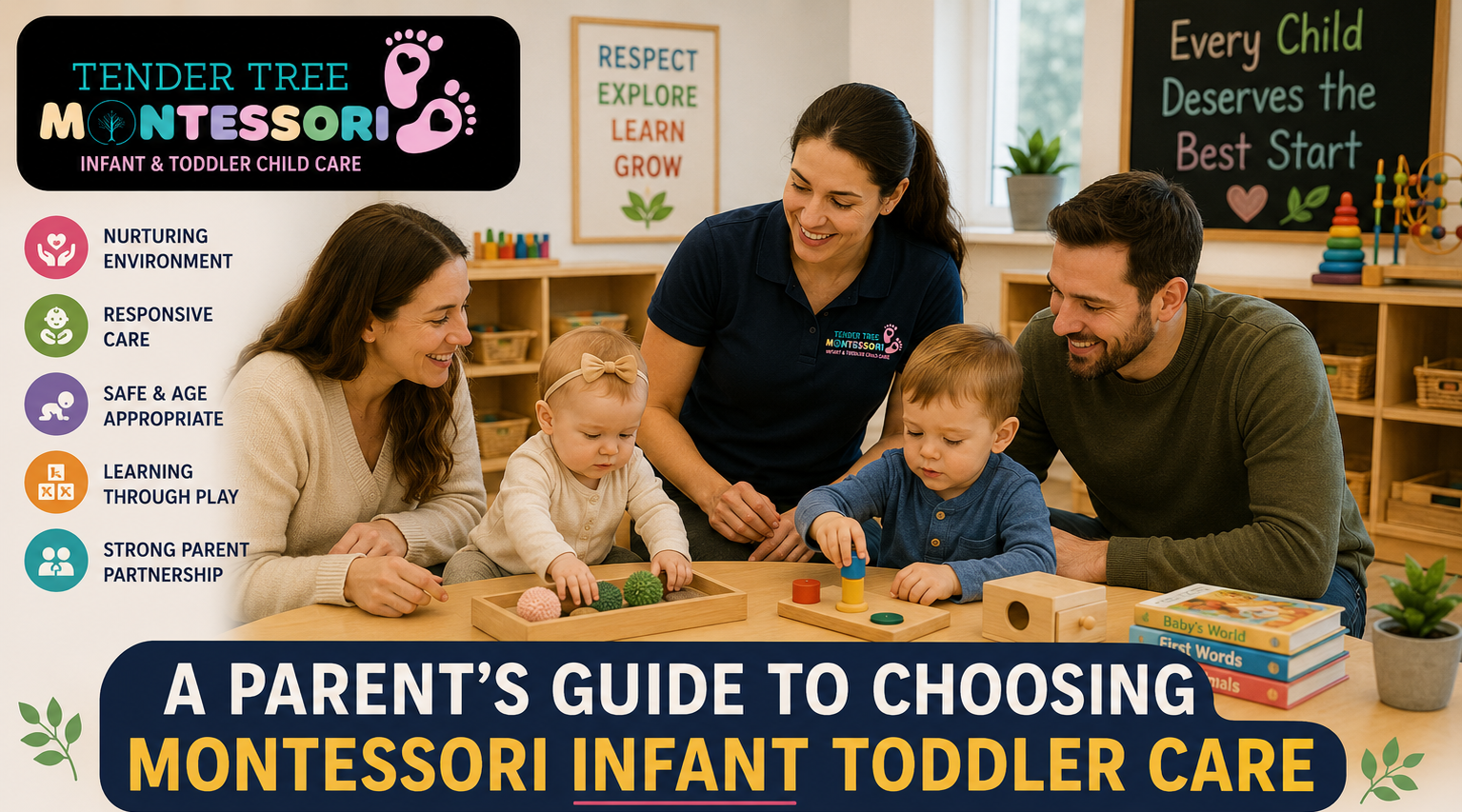
A Parent’s Guide to Choosing Montessori Infant Toddler Care
A Parent’s Guide to Choosing Montessori Infant Toddler Care
Choosing infant or toddler care is one of the most important decisions parents make during the early years. At this stage, children need much more than supervision. They need responsive adults, safe spaces, predictable routines, meaningful interaction, and opportunities to explore.
This is where Montessori Infant Care can offer a distinctive approach.
Montessori education views young children as active learners. Even before children can speak clearly or complete complex tasks, they learn through movement, observation, touch, repetition, relationships, and exploration.
A well-designed Montessori environment gives babies and toddlers opportunities to participate in their surroundings while educators provide guidance and protection.
For families considering Montessori Daycare in Fort McMurray, understanding the principles behind Montessori infant and toddler care can make the selection process easier.
Tender Tree Montessori provides infant and toddler childcare designed to support children’s development through purposeful experiences, respectful interactions, and a carefully prepared environment.
What Is Montessori Infant Care?
Montessori Infant Care is a childcare approach that applies Montessori principles to the unique needs of babies. It does not expect infants to complete formal academic lessons.
Instead, educators create an environment that supports natural development.
The classroom may include safe movement areas, simple sensory materials, age-appropriate furniture, books, practical activities, and opportunities for exploration.
The Prepared Environment
A prepared environment is central to Montessori education.
For infants, this means the space should be:
- Safe and clean
- Calm and organized
- Accessible to children
- Appropriate for developmental stages
- Free from unnecessary clutter
- Equipped with age-appropriate materials
The goal is to allow children to interact with their environment safely.
The Educator’s Role
Montessori educators observe children carefully.
They look at how a child moves, communicates, concentrates, interacts with materials, and responds to new experiences.
Rather than directing every action, educators provide appropriate support and allow children time to explore.
This approach encourages learning while maintaining close supervision and responsive care.
Why Montessori Infant Care Matters
The first years of life involve rapid development. Children develop physical coordination, communication, social awareness, memory, problem-solving abilities, and emotional regulation through everyday experiences.
Research on early childhood development consistently emphasizes the importance of responsive relationships and stimulating environments during the early years.
A quality infant program therefore needs to combine care and learning.
Responsive Relationships Build Security
Babies depend on adults to respond to their needs.
When educators consistently respond to hunger, tiredness, discomfort, communication attempts, and emotional cues, children experience predictable and supportive relationships.
These interactions help create an environment where children can feel secure while exploring.
Movement Supports Development
Infants learn through movement.
They gradually progress from lifting their heads to rolling, sitting, crawling, standing, and walking.
A Montessori environment can provide appropriate floor space and materials that encourage children to practice these skills naturally.
Movement is not simply physical exercise. It also helps children understand space, cause and effect, balance, coordination, and their own capabilities.
What to Look for in Montessori Infant Care
Parents should evaluate more than the Montessori name when choosing childcare.
The actual quality of the environment and relationships matters most.
1. Safe and Appropriate Environment
Safety should always be the first consideration.
Ask about:
- Safe sleep practices
- Child supervision
- Emergency procedures
- Hygiene
- Feeding procedures
- Indoor safety
- Outdoor safety
- Staff-to-child ratios
Parents should also look at whether materials are suitable for the children’s ages.
A beautiful classroom cannot replace proper safety procedures.
2. Responsive Educators
Observe how educators interact with children during your visit.
Do they speak calmly?
Do they respond when children communicate?
Do they comfort children appropriately?
Do they allow children to explore?
Positive adult-child interactions are an important part of high-quality early childhood care.
3. Individualized Care
Every child develops differently.
One toddler may begin walking earlier. Another may spend more time developing language. Some children may need additional time when adapting to a new environment.
A good Montessori Infant Toddler Program observes individual needs instead of expecting every child to follow exactly the same timeline.
Understanding Montessori Toddler Care
As children become toddlers, their need for movement and independence increases.
Montessori Toddler Care builds on the foundation established during infancy.
Toddlers are naturally interested in doing things for themselves. They want to carry objects, wash their hands, put things away, choose activities, and participate in everyday routines.
A Montessori environment can turn these natural interests into learning opportunities.
Practical Life Activities
Practical life activities are simple tasks connected to everyday living.
Examples may include:
- Washing hands
- Putting toys away
- Carrying objects
- Pouring with appropriate materials
- Wiping a table
- Helping with simple classroom routines
- Putting on or removing simple clothing items
These activities can strengthen coordination, concentration, sequencing, and independence.
Why Independence Matters
Independence does not mean leaving toddlers to manage everything alone.
Instead, educators provide appropriate opportunities and support.
A child who successfully completes a simple task may develop confidence in their abilities.
That confidence can encourage them to try more challenging activities.
How Montessori Supports Language Development
Language development begins through relationships and everyday communication.
Educators can talk to babies and toddlers throughout the day rather than limiting language to formal activities.
For example, an educator may describe what is happening during:
- Mealtimes
- Dressing
- Handwashing
- Outdoor play
- Reading
- Cleaning
- Art activities
This gives children repeated exposure to meaningful vocabulary.
Books and Storytelling
Books provide another important language opportunity.
Educators can read age-appropriate stories, name objects, discuss pictures, and encourage toddlers to respond.
Children may point, make sounds, repeat words, or eventually describe what they see.
Montessori Materials and Hands-On Learning
Montessori classrooms often contain simple, purposeful materials.
For infants and toddlers, materials should encourage exploration rather than overwhelm children.
Sensory Materials
Sensory experiences help young children learn through touch, sight, sound, and movement.
Safe materials may vary in:
- Texture
- Shape
- Weight
- Size
- Sound
Educators can observe how children respond and introduce new experiences gradually.
Puzzles and Manipulative Materials
Age-appropriate puzzles and manipulatives can help children develop hand-eye coordination and problem-solving skills.
A toddler may learn how to fit an object into a corresponding space.
The activity appears simple, but it can involve concentration, spatial awareness, coordination, and persistence.
Montessori Infant Toddler Program: What a Day May Include
Every centre has its own schedule, but a Montessori infant toddler program may include a combination of care routines, individual activities, group experiences, movement, outdoor time, meals, and rest.
A typical day might involve:
Morning Arrival
Educators greet children and help them transition into the classroom.
Individual Exploration
Children explore age-appropriate materials while educators observe and support them.
Movement and Outdoor Activities
Children have opportunities to move and explore their surroundings.
Meals and Snacks
Mealtimes provide opportunities for nutrition, communication, and emerging independence.
Rest
Infants and toddlers need appropriate sleep and quiet periods based on their developmental needs.
Practical Activities
Toddlers may participate in simple classroom routines and practical-life tasks.
Story and Language Activities
Books, songs, conversations, and storytelling support communication.
The exact routine should always account for the individual needs and developmental stages of children.
Montessori Daycare vs. Traditional Daycare
Parents often ask whether Montessori daycare is better than traditional daycare.
There is no single childcare model that is best for every child.
The more useful question is whether a specific program provides safe, responsive, developmentally appropriate care.
| Montessori Daycare | Traditional Daycare |
| Prepared learning environment | Structured childcare environment |
| Emphasis on independence | Varies by program |
| Hands-on materials | Variety of toys and activities |
| Observation-based learning | Program-based activities |
| Individual pace encouraged | Group routines often emphasized |
| Practical-life experiences | May include practical activities |
The quality of individual educators, safety procedures, relationships, curriculum, and communication should carry significant weight in a parent’s decision.
Questions to Ask Before Choosing Montessori Childcare
Before enrolling your child, prepare a list of questions.
Ask About the Daily Routine
Find out:
- What does a typical day look like?
- How are naps handled?
- How are meals and snacks managed?
- How much outdoor time do children receive?
- How are transitions handled?
Ask About Development
Ask how educators observe and communicate developmental progress.
You may want to know:
- How do educators track development?
- How are individual interests supported?
- How do teachers handle developmental differences?
- How are parents updated?
Ask About Communication
Good communication helps parents understand what happens during the day.
Ask whether the centre provides updates about:
- Eating
- Sleeping
- Diapering
- Activities
- Mood
- Development
- Important events
Signs of a High-Quality Montessori Childcare Environment
When visiting a Montessori Childcare centre, pay attention to what you see and hear.
Children Appear Engaged
Children should have opportunities to explore rather than spend most of the day waiting.
Educators Interact Respectfully
Adults should communicate calmly and respectfully.
The Environment Is Organized
Materials should have clear purposes and be maintained properly.
Children Have Appropriate Independence
Toddlers should be encouraged to participate in suitable tasks.
Parents Feel Welcome
A strong centre should encourage communication and questions from families.
Safety Is Clearly Prioritized
Safety procedures should be visible, understood, and consistently followed.
Montessori Early Learning in Fort McMurray
Families in Fort McMurray have different childcare requirements. Some parents may be searching specifically for infant care, while others need a program that can support their child through the toddler years.
Montessori Early Learning can be an appealing option for families who value independence, hands-on exploration, purposeful activities, and respectful interactions.
When researching Montessori childcare in Fort McMurray, parents should visit centres in person whenever possible.
A visit can help you evaluate the classroom environment, meet educators, ask questions, and understand how the program handles daily care.
Tender Tree Montessori provides infant and toddler childcare in Fort McMurray and focuses on creating a nurturing environment where young children can explore, develop confidence, and build foundational skills.
For families comparing Montessori Infant Care, Montessori Toddler Care, and other childcare options, the right choice should reflect the child’s needs and the family’s expectations.
Frequently Asked Questions
What is Montessori Infant Care?
Montessori Infant Care is a childcare approach designed around the developmental needs of babies. It combines responsive caregiving with a prepared environment, safe movement, sensory exploration, language-rich interactions, and age-appropriate materials. The approach encourages infants to explore and develop emerging independence while receiving consistent support from caring educators.
Why choose Montessori Toddler Care?
Montessori Toddler Care can support growing independence through practical activities, movement, language, sensory exploration, and hands-on learning. Toddlers can participate in age-appropriate routines while educators provide guidance. This approach can help children develop coordination, concentration, communication, confidence, and early self-help skills in a supportive environment.
How does a Montessori Infant Toddler Program work?
A Montessori Infant Toddler Program combines responsive childcare with purposeful learning experiences. Educators observe children and provide age-appropriate materials, movement opportunities, practical activities, books, and sensory experiences. Daily routines such as meals, rest, hygiene, and transitions are also treated as opportunities for communication and developing independence.
When should parents start looking for Montessori Childcare?
Parents should begin researching Montessori Childcare before they need a placement because availability and enrollment timelines vary by centre. Starting early allows families to compare programs, visit classrooms, ask about safety and routines, understand enrollment requirements, and determine whether the environment matches their child’s developmental and care needs.
Who should consider Montessori Daycare for infants and toddlers?
Montessori Daycare may appeal to parents who value respectful caregiving, hands-on exploration, independence, predictable routines, and child-centered learning. It can be suitable for families seeking an educational approach during the early years. Parents should visit individual centres to determine whether their environment, educators, routines, and philosophy are a good fit.
Conclusion
Choosing childcare for a baby or toddler requires careful consideration. Parents need to look beyond educational labels and examine the complete environment.
Quality Montessori Infant Care should combine safety, responsive relationships, appropriate supervision, meaningful activities, and respect for individual development.
As children grow, Montessori Toddler Care can build on this foundation by introducing practical-life activities, hands-on materials, language experiences, movement, and opportunities for independence.
For families in Fort McMurray exploring a Montessori Infant Toddler Program, Montessori Daycare, Montessori Childcare, or Montessori Early Learning option, visiting the centre is an important step.
Look for caring educators, a prepared environment, clear safety practices, age-appropriate materials, strong parent communication, and a daily routine that supports the whole child.
Tender Tree Montessori provides infant and toddler childcare in Fort McMurray with a focus on nurturing relationships, purposeful learning, exploration, and growing independence.
Contact Tender Tree Montessori at +1 (780) 381-5358 to learn more about Montessori Infant Care and discover whether its Montessori infant toddler program is the right fit for your child and family.