


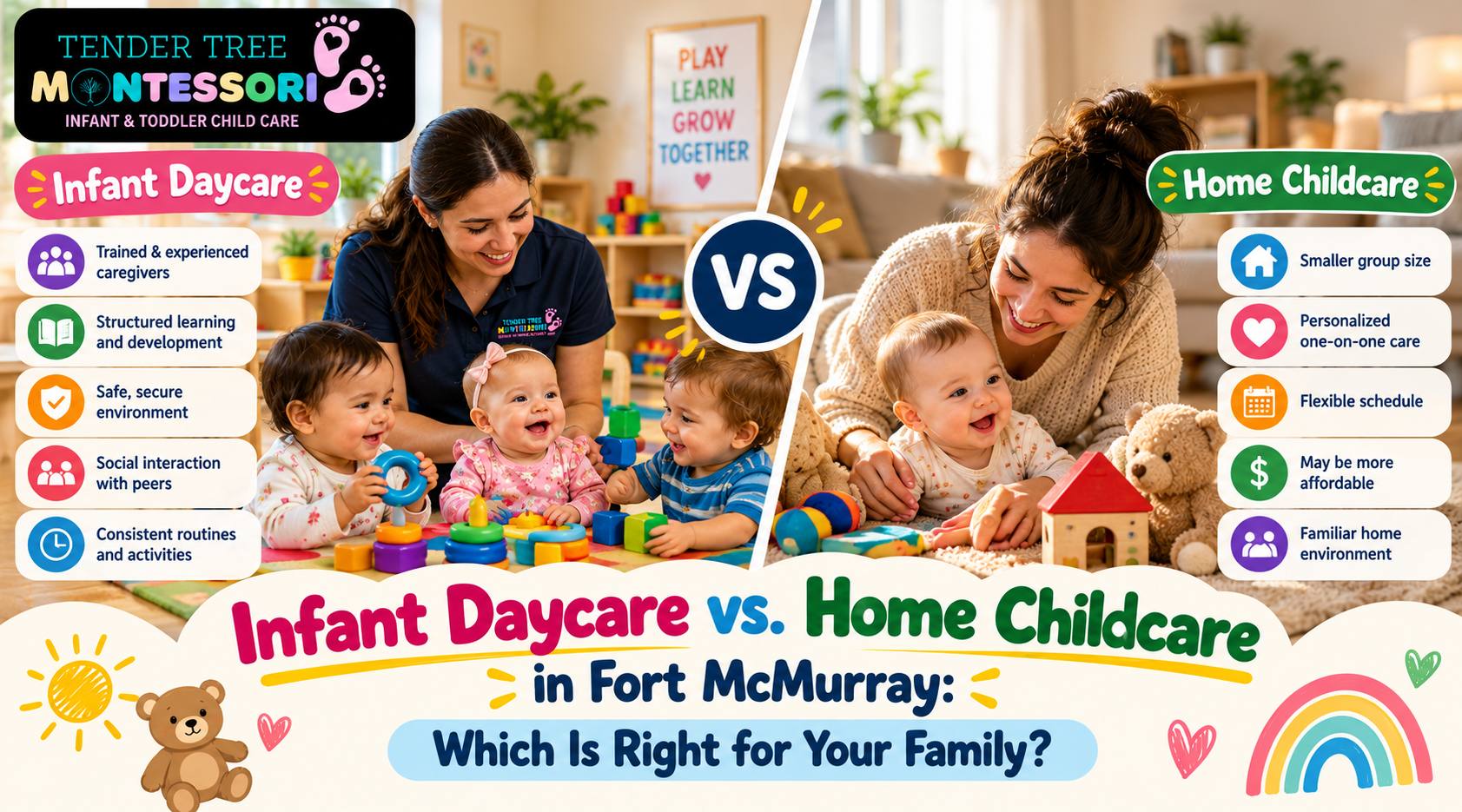
Infant Daycare vs. Home Childcare in Fort McMurray: Which Is Right for Your Family?
Infant Daycare vs. Home Childcare in Fort McMurray: Which Is Right for Your Family?
Returning to work after welcoming a baby can bring many questions. Parents want dependable childcare, but they also want their infant to feel safe, comfortable, and supported throughout the day.
Families searching for Infant Daycare Fort McMurray often compare centre-based childcare with home childcare. Both options can work well when caregivers understand infant development, respond to babies’ needs, and follow appropriate health and safety practices.
However, the two settings may differ in group size, daily routines, available resources, backup arrangements, and opportunities for interaction with other children.
Understanding these differences can help parents make an informed decision. Tender Tree Montessori is a childcare option for families in Fort McMurray who want to explore infant and toddler care. Before choosing any provider, parents should confirm the available age groups, enrolment requirements, operating hours, and suitability for their baby’s needs.
1. What Is Infant Daycare?
Infant daycare is a childcare service designed for babies who are not yet ready for toddler or preschool programs. Care typically focuses on feeding, sleep, hygiene, comfort, supervision, and age-appropriate developmental experiences.
How an Infant Care Centre Works
An infant care centre generally operates within a dedicated childcare facility. Depending on its programs and policies, it may have designated infant spaces, trained educators, play materials, and established procedures for daily care.
Caregivers support babies through activities such as supervised floor play, talking, singing, sensory exploration, and interaction with familiar adults.
Infants need responsive care rather than a rigid schedule. A suitable program adapts feeding, rest, and comfort routines to each baby’s developmental stage and individual needs.
Benefits of Baby Daycare
Baby Daycare Fort McMurray can be a practical option for families who need regular care while working or managing other responsibilities.
Potential benefits include:
- Consistent care arrangements during parents’ working hours.
- Opportunities for sensory exploration and age-appropriate play.
- Established procedures for feeding, rest, hygiene, and communication.
- Access to a childcare team rather than relying on one individual.
- Opportunities to become familiar with a group learning environment as children grow.
The actual experience depends on the provider’s staffing, practices, facilities, and approach to infant care. Parents should visit the centre and ask specific questions before making a decision.
2. What Is Home Childcare?
Home childcare takes place in a private residence or home-based setting operated by a caregiver. The arrangement may involve a small group of children, including infants and children of different ages.
How Home Childcare Works
Home childcare may feel more familiar because the environment resembles a household. Depending on the provider, babies may experience a quieter atmosphere and fewer children than they would in a larger centre.
Caregivers may offer individual attention during feeding, play, and rest. However, the level of attention depends on the number and ages of children present, staffing arrangements, and the caregiver’s experience.
Parents should confirm whether the provider is licensed, what rules apply to the arrangement, and how supervision and emergency procedures work.
Potential Benefits of Home Childcare
Home childcare may suit families who prefer a smaller setting or a caregiver who provides care in a home environment.
Possible advantages include:
- A home-like atmosphere.
- A potentially smaller group of children.
- Familiar daily routines.
- Opportunities for individual interaction with the caregiver.
- Flexible arrangements where the provider offers them.
These benefits are not guaranteed. Parents should evaluate the actual environment, rather than assuming every home-based provider offers smaller groups, greater flexibility, or more individual attention.
3. Infant Daycare vs. Home Childcare: Key Differences
Both childcare options can support an infant’s well-being. The most suitable choice depends on the provider and the family’s priorities.
| Factor | Infant daycare centre | Home childcare |
| Environment | Dedicated childcare facility | Home-based setting |
| Group size | Depends on the licensed program and staffing | Depends on the provider and enrolled children |
| Caregiving team | May involve several educators | May rely mainly on one caregiver |
| Daily routine | Organised around individual infant needs and centre procedures | Organised around individual needs and household routines |
| Learning resources | May include dedicated infant play areas and materials | Depends on the space and available resources |
| Backup care | May have other staff available, but coverage should be confirmed | May depend on the provider’s backup arrangements |
| Social interaction | May offer regular interaction with other children | Depends on the number and ages of children present |
| Operating hours | Set by the centre | Set by the provider |
| Fees | Vary by centre, schedule, and available support | Vary by provider, schedule, and available support |
Neither option is automatically better. A well-run home childcare arrangement may provide excellent care, while a centre-based program may suit a family that values a dedicated facility and a team of educators.
4. Safety and Supervision: What Parents Should Check
Safety should be a primary consideration when choosing an infant care centre in Fort McMurray or a home childcare provider.
Babies depend on adults for nearly every aspect of their care. Parents should understand how caregivers prevent hazards, supervise infants, and respond to emergencies.
Safe Sleep Practices
Ask how the provider follows current safe-sleep guidance. For routine infant sleep, Canadian public health guidance recommends placing babies on their backs on a firm, flat sleep surface in a crib, cradle, or bassinet that meets applicable safety standards.
The sleep space should be free of loose bedding, pillows, and soft objects. Ask whether caregivers follow current public health recommendations and how they monitor sleeping infants.
Hygiene and Feeding Safety
Infant care involves frequent feeding, diaper changes, and cleaning. Ask how caregivers wash their hands, sanitise equipment, prepare and store formula or expressed breast milk, and label each baby’s belongings.
Parents should also explain any allergies, feeding difficulties, or special instructions relevant to their infant.
Emergency Preparedness
Find out how caregivers respond to choking, allergic reactions, injuries, illness, and other emergencies. Confirm the centre’s or provider’s emergency contacts, evacuation procedures, and relevant first-aid training.
For licensed childcare, verify applicable requirements through Alberta’s official childcare licensing resources.
5. Infant Development: Which Setting Supports Learning?
Infants learn through relationships and everyday experiences. They develop communication, movement, attention, and emotional security as responsive adults interact with them.
The Importance of Responsive Care
Responsive caregiving means noticing a baby’s signals and responding appropriately. For example, a caregiver may comfort a crying infant, talk during feeding, or offer a new activity when the baby is alert and interested.
These interactions help babies build trust and explore their surroundings at a comfortable pace.
Sensory and Physical Development
Age-appropriate activities can include supervised tummy time while the baby is awake, reaching for safe toys, listening to songs, and exploring different textures.
Caregivers should adapt activities to each infant’s abilities. They should never leave a baby unattended on an elevated surface or use activities that are unsuitable for the child’s age.
Social and Emotional Growth
Babies begin learning about relationships through familiar voices, facial expressions, gentle interaction, and consistent responses.
A centre may offer opportunities to become familiar with different educators and other children. Home childcare may provide repeated interaction with a primary caregiver. Either setting can support development when adults respond warmly and consistently.
6. Understanding Infant Daycare Age Requirements
Parents often ask when their baby can start daycare. The answer depends on the program’s admission policy, the child’s needs, and applicable provincial rules.
What Is the Minimum Age for Infant Daycare?
There is no single minimum admission age that applies to every childcare provider. Some programs accept young infants, while others set their own minimum age or have limited infant spaces.
Parents searching for Infant Daycare Age Requirements in Fort McMurray should contact providers directly and confirm their current policies.
Ask about the youngest age accepted, enrolment availability, feeding arrangements, sleep routines, required documents, and any settling-in process.
What Should Parents Consider Before Enrolment?
Before starting childcare, discuss your baby’s usual feeding and sleeping patterns, comfort methods, and developmental needs with the provider.
Consider whether your baby can gradually become familiar with the new environment before you return to work. If your infant has particular health or feeding needs, discuss these with the appropriate healthcare professional and childcare provider.
Parents should also confirm current Alberta licensing requirements rather than relying on general online statements about minimum ages or staff-to-child ratios.
Official resource: Government of Alberta, Child Care Lookup and childcare licensing information.
7. Cost, Availability, and Convenience in Fort McMurray
Cost and availability often influence the decision between centre-based infant daycare and home childcare.
Compare the Full Cost of Care
Fees can vary according to the provider, schedule, age group, and services included. Ask whether the quoted fee covers meals, supplies, extended hours, or other services.
Families should also investigate whether they qualify for current Alberta or federal childcare affordability programs. Eligibility, participating providers, and funding arrangements may change, so verify the latest information through official government resources.
Consider Work Schedules and Backup Plans
Parents should compare opening hours, travel time, holiday closures, and late-pickup policies. Fort McMurray’s winter conditions may also affect travel time, so a practical drop-off and pickup route can be important.
Ask what happens if an educator is ill, the provider closes unexpectedly, or your work schedule changes.
A centre may have other educators available, while a home provider may have a different backup arrangement. Confirm the actual policy instead of assuming coverage is guaranteed.
Check Availability Early
Infant spaces can be limited because providers must follow applicable capacity and staffing requirements. Contact potential providers early, ask about waiting lists, and confirm when an enrollment decision is required.
8. How to Choose the Right Infant Care Option
Use this checklist when comparing infant daycare with home childcare.
Questions to ask every provider:
- Is the provider licensed where required, and can I verify the arrangement?
- What are the qualifications and infant-care experience of the caregivers?
- How many children are present, and how is supervision organised?
- What safe-sleep, feeding, hygiene, and emergency procedures are followed?
- How will caregivers share updates about my baby’s day?
- What happens if the regular caregiver is unavailable?
- What are the fees, operating hours, closure policies, and enrollment requirements?
- Can I visit the setting and discuss my baby’s individual needs?
When an Infant Daycare Centre May Suit Your Family
A centre may be worth considering if you prefer a dedicated childcare facility, a team of educators, established procedures, and a program that can support your child as they grow.
Ask how the centre manages continuity of care, infant routines, and communication with parents.
When Home Childcare May Suit Your Family
Home childcare may be worth considering if you prefer a home-like environment or a smaller group, provided the actual arrangement meets your safety and caregiving expectations.
Ask how the caregiver manages multiple children, maintains safe sleep practices, handles emergencies, and arranges backup care.
The right decision is the one that provides dependable, responsive care and fits your family’s practical needs.
9. Infant Childcare in Fort McMurray: Local Considerations
Families in Fort McMurray may need to balance work commitments, commuting, winter weather, and limited availability in their preferred age group.
When visiting an infant care centre, ask about winter arrival procedures, safe indoor movement, outdoor policies for older children, and how the centre communicates during severe weather or unexpected closures.
For home childcare, ask similar questions about transportation, emergency planning, and how the provider maintains a comfortable environment during cold weather.
Tender Tree Montessori is an option for parents exploring infant and toddler childcare in Fort McMurray. Contact the centre directly to confirm whether it currently accepts infants, the minimum admission age, available spaces, fees, and operating hours.
Compare those details with other suitable providers before making your final choice.
Frequently Asked Questions
1. What Is the Difference Between Infant Daycare and Home Childcare?
Infant daycare usually operates in a dedicated childcare facility with educators and established procedures. Home childcare takes place in a residential setting and may involve a smaller group. The quality of care depends on caregiver responsiveness, supervision, safe practices, qualifications, and how well the arrangement meets your baby’s needs.
2. When Can a Baby Start Infant Daycare in Fort McMurray?
A baby can start infant daycare when they meet the provider’s admission requirements and the arrangement can safely meet their needs. Minimum ages vary between providers. Contact centres directly to confirm their current policies, availability, enrolment process, and applicable Alberta licensing requirements before planning your return to work.
3. How Can Parents Choose a Safe Infant Care Centre in Fort McMurray?
Parents should review licensing, caregiver qualifications, supervision, safe-sleep procedures, feeding and hygiene practices, and emergency planning. Visit the setting, ask how caregivers respond to crying and other infant cues, and discuss your baby’s routine. Clear communication and consistent, responsive care are essential when evaluating any childcare arrangement.
4. Why Do Parents Choose Baby Daycare in Fort McMurray?
Parents may choose baby daycare because it provides regular care during working hours, organised routines, and opportunities for age-appropriate play. A centre may also have a team of educators and established procedures. Families should compare individual providers to ensure the program suits their baby’s needs, schedule, and budget.
5. Who Should Choose an Infant Daycare Centre Instead of Home Childcare?
An infant daycare centre may suit parents who prefer a dedicated facility, a team of educators, and established childcare procedures. Home childcare may suit families who prefer a residential setting. Neither option is automatically superior; parents should compare safety, responsiveness, group size, availability, and the quality of care.
Conclusion
Choosing between infant daycare and home childcare is a personal decision. Both options can support healthy development when caregivers provide safe supervision, responsive attention, appropriate routines, and meaningful interactions.
Before enrolling your baby, compare the setting, caregiver experience, licensing, safe-sleep practices, feeding arrangements, fees, availability, and communication policies. Visit potential providers and ask how they will meet your infant’s individual needs.
If you are exploring Infant Daycare Fort McMurray, Tender Tree Montessori can be a starting point for learning about local infant and toddler childcare options. Contact the centre to confirm its current age groups, enrolment availability, and program details.
Ready to explore childcare options for your little one?
Contact Tender Tree Montessori at +1 (780) 381-5358 to discuss your family’s needs and learn more about available childcare services in Fort McMurray.