


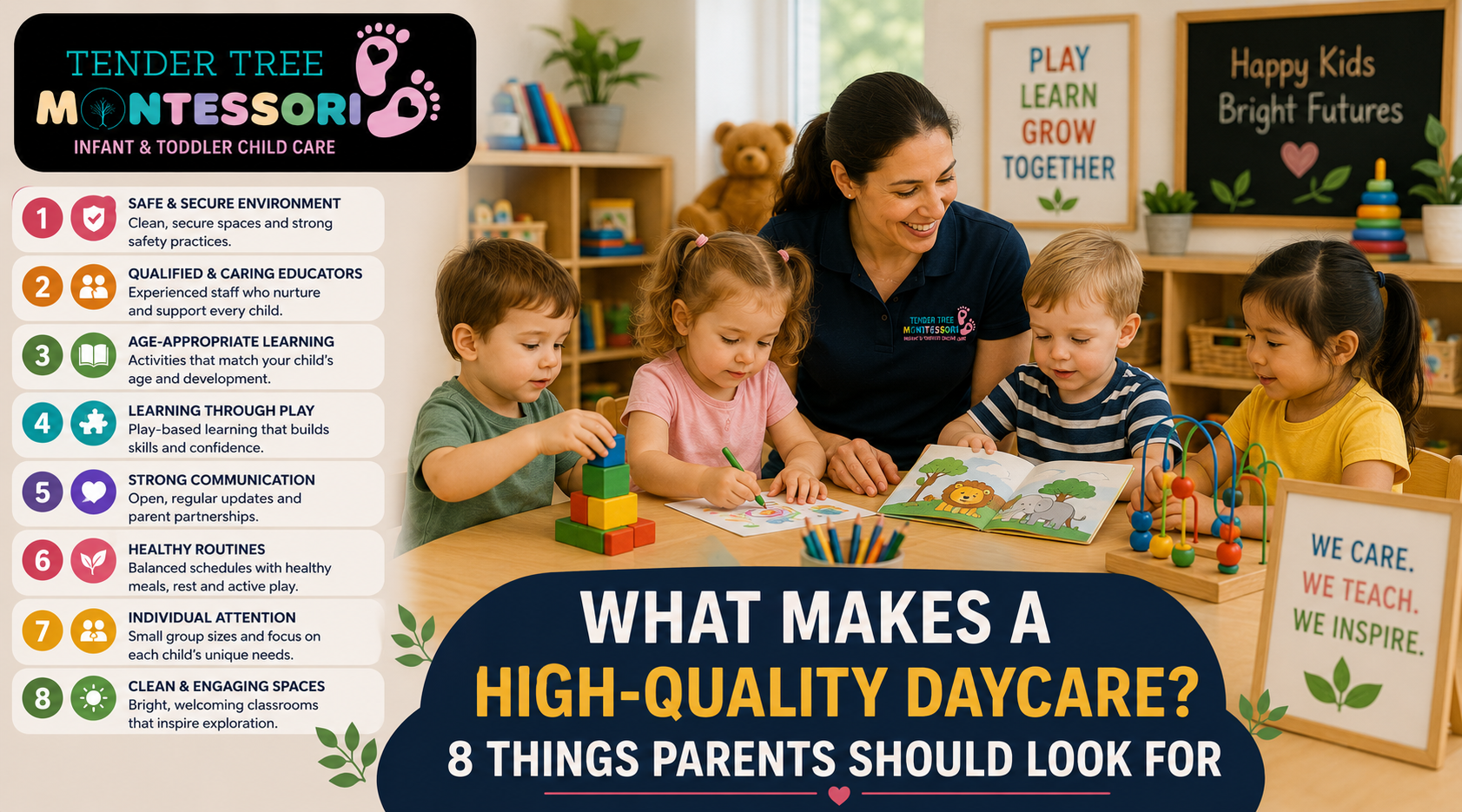
What Makes a High-Quality Daycare? 8 Things Parents Should Look For
What Makes a High-Quality Daycare? 8 Things Parents Should Look For
Choosing childcare is one of the most important decisions parents make during the early years. A daycare is more than a place where children stay while parents work. It can become an important part of a child’s daily learning, social development, and emotional growth.
When searching for a high-quality daycare near me, parents often compare programs based on location, fees, hours, and availability. These factors matter, but they should not be the only considerations.
The quality of the environment, educators, routines, activities, and relationships can have an equally important impact on a child’s experience.
Research in early childhood development consistently emphasizes the importance of responsive relationships and stimulating environments during the early years.
For families in Fort McMurray, finding the right program means looking beyond a website or online rating. Visiting the centre, asking questions, and observing how educators interact with children can provide valuable insight.
So, what should parents look for?
Here are eight important qualities that can help identify quality childcare in Fort McMurray.
1. A Safe, Clean, and Secure Environment
Safety should always come first when evaluating a daycare.
A high-quality childcare centre should have procedures designed to protect children throughout the day. This includes safe entrances, appropriate supervision, clean play areas, secure outdoor spaces, and emergency procedures.
What Parents Should Check
During a visit, look at:
- Entry and exit security
- Classroom cleanliness
- Safe furniture and equipment
- Age-appropriate toys
- Outdoor play areas
- Emergency procedures
- First-aid availability
- Handwashing and hygiene practices
- Safe storage of cleaning products and other hazards
Parents should also ask how the centre handles illnesses, allergies, medication, emergencies, and authorized pickups.
A clean appearance is helpful, but safety should also be part of the centre’s daily systems and routines.
Why Safety Matters
Young children explore through movement and hands-on experiences. A well-designed environment allows children to explore while reducing avoidable hazards.
Families considering the best daycare in Fort McMurray should therefore ask specific safety questions instead of relying only on general statements such as “safe environment.”
2. Qualified and Caring Educators
Educators have a direct influence on a child’s daily experience.
A strong daycare employs educators who understand children’s developmental stages and know how to respond to different personalities, needs, and learning styles.
Look for Responsive Care
Good educators do more than supervise children. They:
- Listen to children.
- Encourage questions.
- Respond calmly to emotions.
- Support independence.
- Model respectful communication.
- Encourage positive social interactions.
- Provide age-appropriate guidance.
Children should feel comfortable approaching educators for help, reassurance, or encouragement.
The National Association for the Education of Young Children emphasizes developmentally appropriate practice and responsive relationships as important elements of quality early childhood education.
Ask About Staff Experience
Parents can ask:
- What qualifications do educators have?
- How are new staff trained?
- Does the centre provide professional development?
- How does the team handle challenging behaviour?
- What is the staff-to-child structure?
These questions can help families understand the quality of care their child will receive.
3. Age-Appropriate Learning and Development
A high-quality daycare should give children opportunities to learn every day.
However, early learning does not mean making young children sit at desks for long periods. Young children learn through play, conversation, exploration, movement, stories, music, art, and hands-on activities.
What Should Children Learn?
A balanced early learning program can support:
- Language and communication
- Early mathematics
- Problem-solving
- Fine motor skills
- Gross motor development
- Social skills
- Emotional awareness
- Creativity
- Independence
- Concentration
Activities should match children’s ages and developmental stages.
For example, toddlers may benefit from sensory exploration and simple sorting activities, while older preschoolers may explore early literacy, counting, patterns, science, and practical life skills.
Parents looking for a high-quality daycare in Fort McMurray should ask to see examples of the centre’s daily learning activities.
4. Learning Through Play
Play is a central part of early childhood learning.
Children use play to test ideas, develop language, practice social skills, solve problems, and understand the world around them.
A quality daycare should therefore provide enough time for meaningful, child-friendly play.
Different Types of Play Matter
A strong program can include:
Creative play:
Art, drawing, music, crafts, and imaginative activities encourage self-expression.
Physical play:
Running, climbing, balancing, dancing, and outdoor activities support physical development.
Social play:
Group activities help children learn sharing, cooperation, communication, and conflict resolution.
Independent play:
Children need opportunities to choose activities and work at their own pace.
Guided play:
Educators can introduce questions, materials, or challenges that extend children’s learning.
The goal is balance. Children need both adult guidance and opportunities to explore independently.
5. Strong Communication With Parents
Parents should know what happens during their child’s day.
A high-quality daycare encourages two-way communication. Educators should share relevant information about meals, naps, activities, mood, learning progress, and important events.
Questions to Ask
Before enrolling, ask:
- How do educators communicate with parents?
- Are daily updates provided?
- How are developmental concerns discussed?
- How can parents raise questions?
- Are parent meetings available?
- How does the centre share important announcements?
Communication should not happen only when there is a problem.
Positive updates are important too. Parents appreciate knowing when their child learns something new, makes a friend, tries a new activity, or reaches a developmental milestone.
Strong communication also helps educators understand the child better because parents can share information about interests, routines, preferences, and changes at home.
6. Healthy Daily Routines
Young children benefit from predictable routines.
A well-organized daycare should have a daily schedule that provides structure while still allowing flexibility when children need additional support.
A Balanced Day May Include
- Arrival and welcome time
- Free-choice activities
- Guided learning
- Outdoor play
- Meals and snacks
- Rest or quiet time
- Stories and language activities
- Creative activities
- Social interaction
- Departure routines
Predictability can help children understand what comes next and feel more comfortable in a new environment.
At the same time, educators should recognize that children do not all have identical needs. A responsive program can maintain structure without treating every child exactly the same.
7. Individual Attention and Emotional Support
Every child develops differently.
One child may confidently join group activities, while another may need more time. Some children communicate quickly, while others need additional encouragement.
A quality childcare program recognizes these differences.
Look for Individualized Support
Educators should observe children’s interests and development and use that information to plan meaningful experiences.
They should also help children develop emotional skills such as:
- Naming feelings
- Expressing needs
- Waiting for a turn
- Handling frustration
- Building friendships
- Asking for help
- Solving simple conflicts
Responsive educators do not simply tell children to “calm down.” They help children understand emotions and gradually develop strategies for managing them.
Early emotional and social development is closely connected with children’s relationships and learning experiences.
8. A Welcoming Philosophy That Matches Your Family
Every family has different priorities.
Some parents may want a Montessori environment. Others may prefer a play-based program, a bilingual environment, or a traditional early learning approach.
The best daycare in Fort McMurray is not necessarily the same for every family.
Consider Your Family’s Priorities
Think about:
- Your child’s age
- Your work schedule
- Transportation needs
- Program philosophy
- Language exposure
- Outdoor opportunities
- Meal policies
- Nap routines
- Learning approach
- Communication style
- Centre hours
- Your child’s personality
The right environment should feel like a good fit for both the child and the family.
Parents should not hesitate to visit several centres before making a decision.
How to Evaluate a Daycare During a Visit
Searching online for a daycare near me can create a useful shortlist. However, an in-person visit provides information that a website cannot.
Observe the Classroom
Pay attention to how children behave.
Do they appear comfortable and engaged? Are educators talking with them? Are activities organized and accessible?
Also notice whether educators get down to children’s level when communicating with them.
Ask Direct Questions
Prepare questions before your visit. Ask about safety, staff, routines, learning activities, outdoor time, meals, rest, communication, and policies.
A reputable centre should be comfortable answering reasonable questions.
Trust Your Observations
Parents know their children well.
Consider whether the environment seems appropriate for your child’s personality and developmental stage. A quiet child may need a different environment than a highly active child.
The physical environment matters, but relationships matter too.
Choosing Childcare in Fort McMurray
Families in Fort McMurray have different schedules, family structures, and childcare requirements. Local convenience is important, especially for parents managing work, school, transportation, and family responsibilities.
When comparing high-quality daycare Fort McMurray options, consider both practical and developmental factors.
Location and Transportation
A centre near home or work can make daily drop-offs and pickups easier.
However, a slightly longer drive may be worthwhile if the program offers an environment that better fits your child’s needs.
Weather and Outdoor Activities
Fort McMurray experiences significant seasonal changes. Parents should ask how the centre manages outdoor activities throughout the year.
Find out how outdoor play is incorporated during suitable weather and how the centre handles seasonal clothing and indoor alternatives.
Community and Family Connection
A strong local childcare centre can also help children build relationships within their community.
For families researching daycare near me, location should be considered alongside safety, educators, learning opportunities, communication, and overall quality.
Red Flags Parents Should Watch For
While every centre is different, certain concerns deserve closer attention.
Parents should ask additional questions if they notice:
- Poor cleanliness
- Unclear safety procedures
- Limited supervision
- Educators who rarely interact with children
- Lack of age-appropriate activities
- High staff turnover without clear explanation
- Poor communication
- Unclear policies
- A classroom that feels overly restrictive
- Promises that sound unrealistic
One concern does not automatically mean a centre is unsuitable. However, several concerns together may justify comparing other options.
How Tender Tree Montessori Supports Families
Tender Tree Montessori provides childcare services for families looking for an early learning environment in Fort McMurray.
A Montessori-inspired approach can emphasize independence, hands-on learning, practical activities, concentration, and respect for each child’s development.
For parents, the goal should be more than finding available childcare. It should be finding an environment where children can feel safe, supported, curious, and encouraged to learn.
Families can explore how the program fits their child’s needs, daily schedule, and learning goals before making an enrollment decision.
Frequently Asked Questions
Q1: What makes a high-quality daycare?
A high-quality daycare provides a safe, clean environment, qualified educators, appropriate supervision, meaningful learning activities, healthy routines, and responsive care. It also communicates clearly with parents and supports children’s social, emotional, physical, and cognitive development. The program should respect individual differences and provide opportunities for play, exploration, and independence.
Q2: How can I find a high-quality daycare near me?
To find a high-quality daycare near you, create a shortlist based on location, hours, program philosophy, and availability. Then visit each centre, observe educator-child interactions, review safety practices, ask about daily routines, and discuss communication policies. An in-person visit helps you compare the environment more accurately.
Q3: Why is play important in daycare?
Play is important because young children learn through active exploration and interaction. Play supports communication, problem-solving, creativity, motor skills, emotional development, and social skills. A strong daycare combines child-led play with educator-guided activities so children can explore freely while receiving appropriate challenges and support.
Q4: What should parents ask during a daycare tour?
Parents should ask about educator qualifications, supervision, group sizes, daily schedules, learning activities, outdoor play, meals, naps, illness policies, emergency procedures, communication, and enrollment requirements. They should also ask how educators support individual children’s needs and handle emotional or behavioural challenges.
Q5: How do I choose the best daycare in Fort McMurray?
Choose the best daycare by comparing safety, educators, learning opportunities, routines, communication, location, hours, and program philosophy. Visit potential centres and consider how each environment matches your child’s age, personality, interests, and needs. The right daycare should provide dependable care while creating a positive environment for learning and development.
Conclusion
Choosing a high-quality daycare in Fort McMurray requires more than searching for the closest available centre. Parents should evaluate safety, educators, learning experiences, play opportunities, routines, communication, emotional support, and the overall philosophy of the program.
The right childcare environment should help children feel secure while encouraging curiosity, independence, social development, and a love of learning.
Take time to visit potential programs, ask questions, and observe how educators interact with children. Most importantly, consider which environment feels right for your child and your family.
If you are looking for quality childcare in Fort McMurray, Tender Tree Montessori is ready to help you learn more about its early learning environment and childcare options.
Contact Tender Tree Montessori today at +1 (780) 381-5358 to discuss your child’s childcare needs and learn more about the program.