


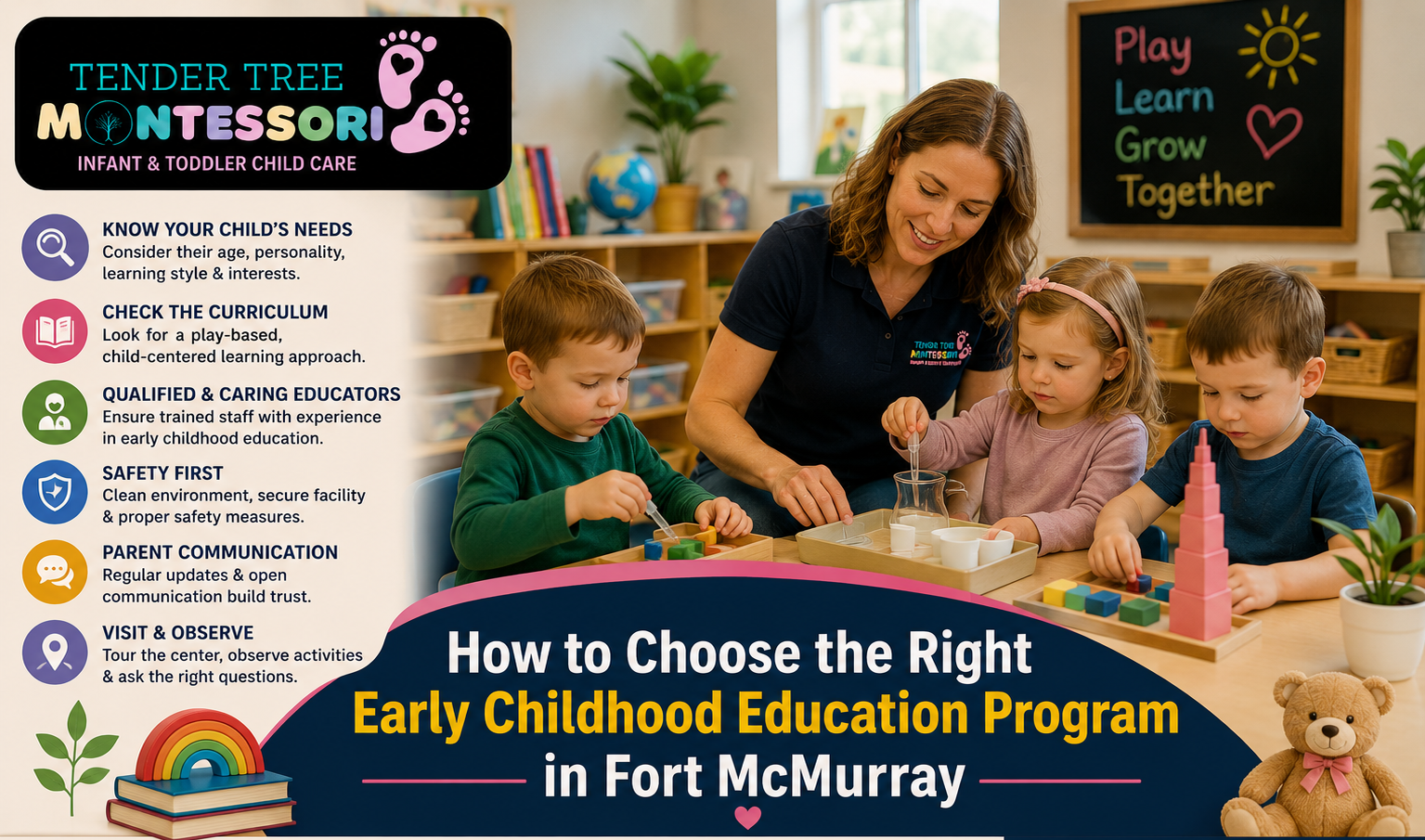
How to Choose the Right Early Childhood Education Program in Fort McMurray
How to Choose the Right Early Childhood Education Program in Fort McMurray
Choosing childcare is an important decision for every family. Parents want a place where their children are safe, respected, supported, and encouraged to learn.
The early years are a major period of growth. Children develop language, movement, social skills, emotional awareness, problem-solving abilities, and independence through everyday experiences.
That is why choosing early childhood education Fort McMurray families can trust involves more than finding an available space. The right program should provide a supportive environment where children can explore, ask questions, interact with others, and develop skills at an appropriate pace.
Families in Fort McMurray have different schedules and priorities. Some need full-day care, while others are looking for preschool preparation or a structured early learning environment.
Understanding what to look for can make the decision easier.
What Is Early Childhood Education?
Early childhood education refers to learning and development experiences designed for young children before they enter or progress through formal elementary education.
A quality program combines learning with age-appropriate play, social interaction, movement, creativity, communication, and practical activities.
Early Learning Is More Than Academic Preparation
Young children do not need a program focused only on letters, numbers, or worksheets.
They also need opportunities to:
- Build relationships.
- Communicate with others.
- Solve simple problems.
- Make choices.
- Practice independence.
- Develop fine and gross motor skills.
- Express emotions appropriately.
- Explore their surroundings.
- Learn through hands-on activities.
Expert insight: Early childhood programs are most effective when learning experiences support the whole child rather than focusing on academic skills alone.
1. Understand Your Child’s Needs First
Before comparing early learning Fort McMurray options, think about your child’s individual needs.
Every child has a different personality and learning style. Some children quickly engage with new people. Others need more time to feel comfortable.
Consider Your Child’s Age
A program should provide activities appropriate for your child’s developmental stage.
Ask how educators adapt activities for different abilities and interests.
Consider Your Child’s Personality
Think about whether your child enjoys:
- Quiet activities
- Group activities
- Outdoor play
- Creative projects
- Music and movement
- Building and problem-solving
- Independent exploration
A program that understands individual differences can make the transition into childcare or preschool easier.
Consider Special Learning Needs
If your child has specific developmental, communication, behavioural, or learning needs, discuss them with the program before enrolling.
Ask what support the educators can provide and how they communicate with families about development.
2. Research the Program’s Educational Philosophy
Different early learning programs Fort McMurray may use different teaching philosophies.
Some programs emphasize structured learning. Others focus more heavily on child-led exploration, hands-on activities, practical life skills, or play-based learning.
The most important question is whether the philosophy fits your child and your family’s expectations.
Ask How Children Learn
During a tour, ask:
- How is the daily schedule organized?
- How much time is dedicated to free play?
- How do educators introduce new concepts?
- How are children’s interests incorporated?
- How are activities adapted for different developmental levels?
- How do educators encourage independence?
A good program should be able to explain its approach clearly.
3. Visit the Facility in Person
Online information can help you create a shortlist. However, visiting a program gives you information that a website cannot provide.
Pay attention to how the environment feels when you arrive.
Observe the Learning Environment
Look for a space that is:
- Clean and organized
- Comfortable for children
- Safe and secure
- Bright and welcoming
- Designed for age-appropriate activities
- Equipped with suitable learning materials
Notice how educators interact with children.
Do they listen? Do they speak respectfully? Do children appear engaged and comfortable?
These observations can tell you a great deal about the program.
4. Ask About Educator Qualifications
Educators have a major influence on children’s experiences.
Ask about staff training, qualifications, experience, and ongoing professional development.
Why Educators Matter
Young children learn through relationships and interactions.
A skilled educator can help a child develop communication, confidence, cooperation, emotional regulation, and independence.
Ask:
- What qualifications do educators hold?
- How long have educators worked in early childhood education?
- Does the program provide ongoing training?
- How does staff turnover affect classroom consistency?
- Who supervises children throughout the day?
Data point: Educator-to-child ratios are an important part of evaluating a childcare environment because they affect supervision and the amount of individual attention educators can provide. Ask the program about its applicable ratios and how staffing is maintained throughout the day.
5. Evaluate Safety and Security
Safety should be one of your highest priorities when choosing childcare Fort McMurray families can rely on.
Ask how the facility protects children during normal activities and emergencies.
Questions to Ask About Safety
Find out about:
- Secure entry and exit procedures
- Visitor policies
- Emergency plans
- Fire safety
- First-aid procedures
- Staff background screening
- Supervision practices
- Playground safety
- Medication procedures
- Allergy management
You should feel comfortable asking detailed questions.
A trustworthy childcare provider should be transparent about its safety procedures.
6. Look at the Daily Schedule
Children benefit from predictable routines. A well-planned daily schedule can help children understand what happens next while still allowing flexibility.
Ask to see a typical day.
A Balanced Day May Include
- Arrival and welcome activities
- Free-choice play
- Group activities
- Reading
- Creative projects
- Outdoor play
- Meals and snacks
- Rest or quiet time
- Practical activities
- Individual exploration
The schedule should provide a balance between structured activities and opportunities for children to make choices.
7. Ask About Outdoor Play
Outdoor play is an important part of early childhood development.
Children need opportunities to move, explore, interact, and develop physical skills.
When evaluating early learning Fort McMurray programs, ask how often children go outside and how the program handles outdoor activities during different weather conditions.
Why Outdoor Activities Matter
Outdoor experiences can support:
- Balance and coordination
- Physical fitness
- Social interaction
- Confidence
- Observation skills
- Creativity
- Environmental awareness
For families in Fort McMurray, it is especially useful to understand how the program plans outdoor activities around local seasonal conditions.
8. Evaluate Communication With Parents
Good communication creates a stronger connection between the family and the education team.
Ask how the program shares information about your child’s day.
Questions to Ask
Does the program provide:
- Daily updates?
- Parent meetings?
- Progress discussions?
- Written or digital communication?
- Information about meals and naps?
- Notifications about incidents?
- Opportunities for parents to share concerns?
Parents should know who to contact when they have a question.
Open communication also helps educators understand changes in a child’s home routine, interests, or needs.
9. Consider the Program’s Approach to Behaviour
Children are still learning how to manage emotions and interact with others.
Ask how educators respond when children become frustrated, upset, or have difficulty following expectations.
Look for Positive Guidance
A strong program should teach children appropriate behaviour rather than relying only on punishment.
Ask:
- How do educators resolve conflicts?
- How do they help children identify emotions?
- How are classroom expectations explained?
- How are challenging behaviours handled?
- How are parents involved when concerns continue?
The goal should be to help children build self-regulation, communication, and problem-solving skills.
10. Compare Meals, Nutrition, and Allergies
If the program provides meals or snacks, ask what food is offered and how dietary needs are managed.
Important Questions
Find out:
- Are meals prepared on-site?
- Are snacks included?
- How are allergies handled?
- How are food restrictions communicated to staff?
- Do children have access to water?
- How are mealtimes supervised?
Nutrition is an important part of a child’s daily routine, so families should understand exactly what a program provides.
11. Check Hours, Location, and Availability
The best educational philosophy will not work for your family if the schedule is impractical.
Consider:
- Opening and closing times
- Location
- Transportation
- Drop-off procedures
- Pick-up policies
- Holiday closures
- Vacation policies
- Waitlist requirements
- Enrollment availability
For working parents, reliable scheduling can be just as important as the classroom environment.
Balance Convenience With Quality
A nearby program can save travel time. However, location should not be the only deciding factor.
Compare convenience with safety, educational quality, educator experience, communication, and your child’s comfort.
12. Compare Costs and What Is Included
Childcare and preschool costs can vary depending on the program, schedule, services, and applicable funding or fee arrangements.
Do not compare prices alone.
Instead, ask what the cost includes.
Ask About Additional Fees
Potential costs may include:
- Registration fees
- Meals
- Special activities
- Field trips
- Extended hours
- Supplies
- Late pickup fees
Request a clear explanation of the total expected cost before enrollment.
13. Read Reviews, But Look Beyond Ratings
Online reviews can help you identify common experiences. However, reviews should be only one part of your research.
Look for patterns rather than focusing on one positive or negative comment.
Consider comments about:
- Communication
- Educator consistency
- Cleanliness
- Safety
- Learning activities
- Staff responsiveness
- Parent experience
Then verify what you read by visiting the program and asking direct questions.
Choosing Early Childhood Education in Fort McMurray
Families searching for early childhood education Fort McMurray options should consider both educational quality and local family needs.
Fort McMurray families may have demanding work schedules, changing routines, and different childcare requirements. A suitable program should offer clear policies, reliable communication, and an environment that supports children’s development.
When comparing preschool Fort McMurray options, ask whether the program prepares children for their next stage while still respecting the way young children learn.
The right program should make children feel safe, valued, curious, and confident.
A Simple Checklist for Parents
Before enrolling, use this checklist:
Program Quality
- Educational philosophy matches your family.
- Activities are age-appropriate.
- Children receive opportunities for play and exploration.
- Educators encourage independence.
Safety
- Security procedures are clearly explained.
- Emergency procedures are established.
- Staff qualifications and screening are clear.
- Supervision practices meet applicable requirements.
Daily Experience
- Schedule includes indoor and outdoor activities.
- Children have opportunities for creative play.
- Meals and allergies are properly managed.
- Behaviour guidance is respectful.
Family Communication
- Parents receive regular updates.
- Staff are approachable.
- Concerns can be discussed easily.
- Policies are clearly explained.
Practical Considerations
- Location works for your family.
- Hours fit your schedule.
- Fees are clearly explained.
- Enrollment and waitlist procedures are understood.
Frequently Asked Questions
What should I look for in an early childhood education program?
Look for qualified educators, a safe and welcoming environment, age-appropriate learning activities, positive behaviour guidance, outdoor play, clear communication, and appropriate supervision. The program should also match your child’s developmental needs and your family’s schedule. Visiting the facility is one of the best ways to evaluate these factors.
Why is play important in early childhood education?
Play helps young children develop social, emotional, physical, language, and problem-solving skills. Through play, children can explore ideas, practice communication, make decisions, and learn how to cooperate. A strong early learning program uses purposeful play alongside age-appropriate structured activities to support whole-child development.
How can I compare childcare options in Fort McMurray?
Compare programs based on safety, educator qualifications, learning philosophy, daily routines, outdoor activities, communication, fees, hours, and location. Visit your shortlisted programs and ask the same core questions at each one. This makes it easier to compare services objectively rather than choosing based only on availability or price.
When should I start looking for childcare in Fort McMurray?
Start researching childcare as early as possible, especially if you need care for a specific start date. Some programs may have limited availability or waiting lists. Beginning early gives you time to visit several facilities, compare programs, understand enrollment requirements, and choose an option that best fits your child’s needs.
Who can help me choose the right preschool or childcare program?
Parents should start by identifying their child’s needs and then speak directly with program administrators and educators. Ask about learning methods, safety, staffing, routines, communication, and enrollment. Visiting several early learning programs Fort McMurray can provide valuable insight before making a final decision.
Conclusion
Choosing an early learning program is an important investment in your child’s early experiences. The right environment should provide more than supervision. It should encourage curiosity, independence, communication, creativity, confidence, and positive relationships.
When comparing early childhood education Fort McMurray options, take time to visit programs, meet educators, review policies, observe the environment, and ask questions. Your child’s comfort and developmental needs should remain at the centre of the decision.
Tender Tree Montessori provides families with an early learning environment designed to support children’s development through meaningful experiences and age-appropriate learning.
If you are exploring early learning Fort McMurray options for your child, contact Tender Tree Montessori at +1 (780) 381-5358 to learn more about the program and discuss your family’s childcare needs.