

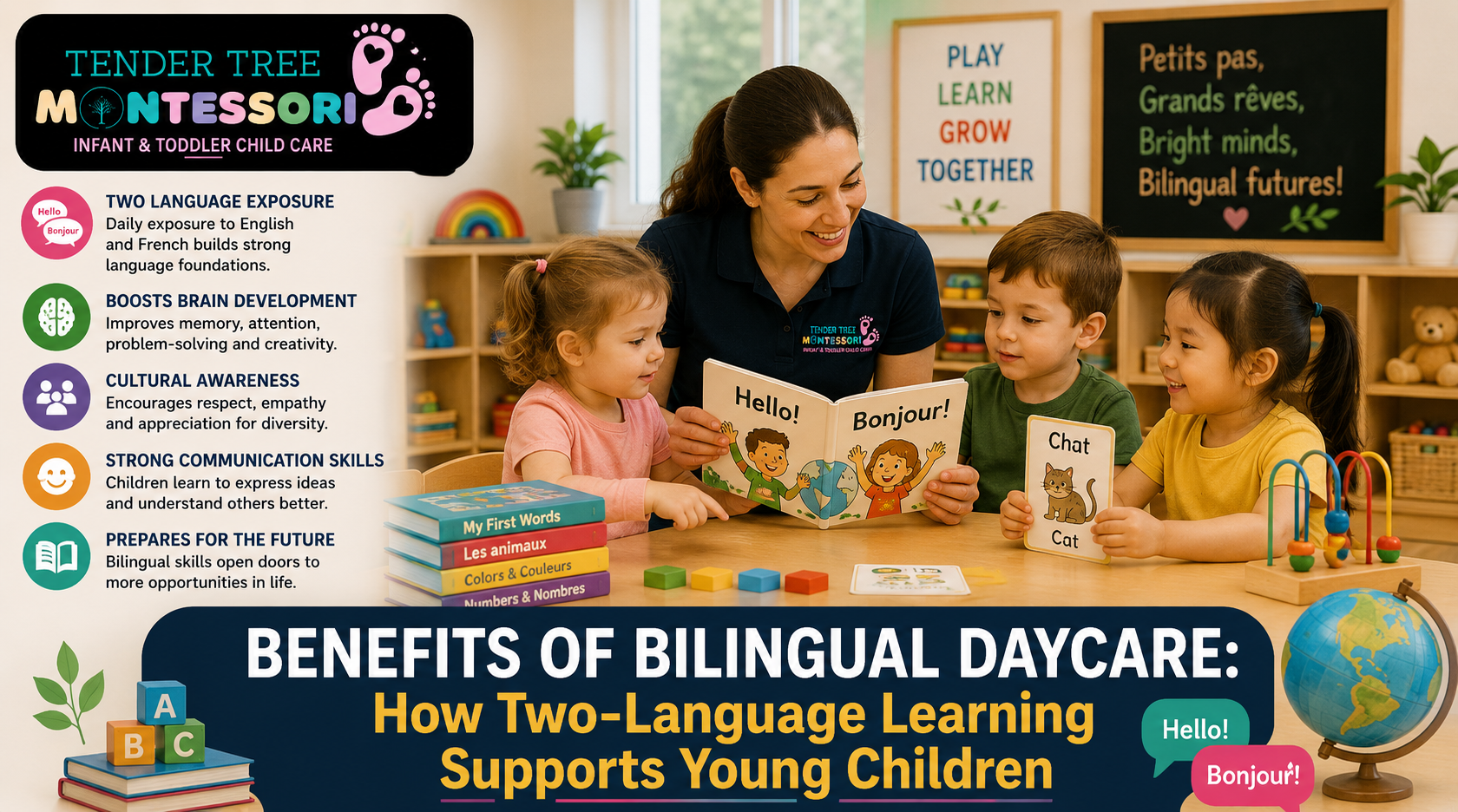
Benefits of Bilingual Daycare: How Two-Language Learning Supports Young Children
Benefits of Bilingual Daycare: How Two-Language Learning Supports Young Children
Choosing childcare is an important decision for any family. Parents want their children to feel safe, supported, and ready to learn. For families interested in two languages, a bilingual program can provide an additional learning opportunity during the early years.
Searching for a bilingual daycare near me often leads parents to compare programs based on location, hours, cost, curriculum, and language offerings. However, the quality of the learning environment matters just as much as the number of languages offered.
A good bilingual daycare does not simply teach children vocabulary. It creates everyday opportunities to listen, communicate, play, explore, and build relationships in two languages.
For families in Fort McMurray, understanding how bilingual childcare works can make the selection process easier. This guide explains the major benefits, what parents should look for, and how to decide whether bilingual daycare is right for their child.
What Is Bilingual Daycare?
Bilingual daycare is an early childhood setting where children are regularly exposed to two languages as part of their daily routines and learning experiences.
The two languages may be used during activities such as:
- Storytelling
- Songs and music
- Games
- Art activities
- Mealtimes
- Outdoor play
- Classroom routines
- Conversations with educators
- Group activities
The exact approach varies between programs. Some centres use both languages throughout the day. Others may assign specific activities, educators, or parts of the day to each language.
The goal is not necessarily to make children perfectly fluent immediately. Instead, consistent exposure helps children become comfortable hearing and using both languages.
Bilingual Learning Is More Than Translation
Effective bilingual childcare does not mean translating every sentence from one language into another.
Instead, educators can use gestures, pictures, repetition, demonstrations, songs, and real-life situations to help children understand meaning.
For example, an educator may introduce a new word while showing the object. The child can then connect the sound with the item, action, or experience.
This makes language learning natural rather than stressful.
Benefits of Bilingual Daycare for Young Children
1. Supports Early Communication Skills
Young children learn language through interaction. They listen to adults, imitate sounds, practice words, and gradually learn how to express their needs.
A bilingual environment gives children more opportunities to listen carefully and understand different ways of communicating.
Children may develop awareness of:
- Different sounds
- Vocabulary
- Sentence patterns
- Conversation
- Listening cues
- Meaning from context
Research on bilingual development indicates that children can successfully learn multiple languages when they receive meaningful and consistent exposure.
However, every child develops at a different pace. Parents should focus on steady progress rather than comparing one child’s language skills with another’s.
2. Encourages Cognitive Flexibility
Learning two languages requires children to pay attention to which words and language patterns fit different situations.
This can provide regular practice in switching between linguistic systems and paying attention to context.
Cognitive flexibility refers to the ability to adjust thinking when circumstances change. Activities that require children to listen, remember instructions, solve problems, and shift between tasks can support broader learning skills.
Importantly, bilingualism should not be viewed as a guarantee of higher intelligence. Children’s development depends on many factors, including relationships, learning experiences, sleep, nutrition, environment, and individual differences.
Learning Happens Through Everyday Activities
Children do not need formal lectures to develop these skills.
A teacher might ask children to:
- Listen to instructions.
- Identify an object.
- Respond using a familiar word.
- Change activities.
- Work with another child.
These simple experiences encourage attention, memory, communication, and flexible thinking.
3. Builds Cultural Awareness
Language and culture are closely connected.
A bilingual childcare program can introduce children to different songs, stories, celebrations, traditions, and ways of communicating.
This exposure can help children understand that families may speak different languages and have different traditions.
For multicultural communities such as Fort McMurray, this can be particularly valuable. Children regularly interact with people from different backgrounds, and early exposure can help make diversity feel normal and positive.
Respect Starts Early
Children learn social attitudes partly through the environment around them.
When educators treat different languages and cultures with respect, children can learn to appreciate differences rather than fear them.
This creates opportunities to discuss:
- Family traditions
- Languages
- Food
- Music
- Stories
- Community
- Respect
4. Can Increase Confidence in Communication
Some children become more confident communicators when they have regular opportunities to interact with supportive educators and peers.
A quality bilingual program gives children time to experiment with language without making mistakes feel embarrassing.
Educators can encourage children through repetition and positive feedback.
For example, if a child uses a new word incorrectly, the educator can model the correct word naturally instead of creating pressure.
This approach helps children understand that learning a language is a process.
5. Makes Language Learning Natural
One of the biggest advantages of bilingual childcare is regular exposure.
Children hear language during real activities instead of only during a short language lesson.
For example, a teacher may use language while:
- Washing hands
- Preparing snacks
- Cleaning up
- Reading a book
- Playing outdoors
- Building with blocks
- Completing an art project
This connects words with real experiences.
Repeated exposure can also help children recognize sounds and phrases over time.
Bilingual Daycare and Social Development
Language is also a social tool.
Children use communication to make friends, share toys, solve disagreements, ask questions, and participate in group activities.
A bilingual environment can encourage children to listen closely and observe how others communicate.
Learning to Listen
Listening is a major part of language development.
Children need to understand instructions, recognize questions, and pay attention to conversations.
Educators can strengthen listening skills through:
- Storytime
- Songs
- Rhymes
- Group games
- Questions
- Interactive conversations
These activities can support both language development and social participation.
How to Choose a Bilingual Daycare in Fort McMurray
Finding a bilingual daycare centre near me is only the first step. Parents should look beyond the location.
1. Ask How Languages Are Used
Ask the centre:
- Which two languages are offered?
- How often does each language appear during the day?
- Are both languages used during play?
- Do educators speak naturally with children?
- Is language exposure age-appropriate?
A strong program should clearly explain its language approach.
2. Review Staff Qualifications
Educators have a major influence on children’s experiences.
Ask about educator qualifications, experience, training, and familiarity with bilingual early learning.
A French bilingual daycare Fort McMurray program, for example, should be able to explain how French is incorporated into children’s daily experiences if French is one of the program’s languages.
3. Look at the Learning Environment
Visit the centre when possible.
Look for an environment that is:
- Clean
- Safe
- Organized
- Child-friendly
- Age-appropriate
- Warm and welcoming
Children should have access to books, toys, creative materials, and activities that encourage exploration.
4. Ask About Parent Communication
Parent communication is essential.
Ask how the centre shares information about:
- Daily routines
- Meals
- Rest
- Activities
- Development
- Language progress
- Behaviour
- Important concerns
Parents should feel comfortable asking questions and discussing their child’s needs.
What Parents Should Know About Language Development
Parents sometimes worry that learning two languages will confuse a young child.
Research does not support the idea that simply hearing two languages causes developmental confusion. Children can learn to distinguish languages based on sounds, people, situations, and context.
However, language development varies significantly between children.
Some children may use words from both languages in the same sentence. This is often called code-switching. It can be a normal part of bilingual language development.
Parents should consider the child’s total language exposure across home and childcare rather than looking at only one language.
Home and Daycare Should Work Together
Parents can support bilingual development by making both languages part of everyday life.
Simple activities include:
- Reading books
- Singing songs
- Talking during meals
- Naming objects
- Telling stories
- Asking open-ended questions
- Discussing daily activities
Consistency matters more than complicated teaching methods.
Why Bilingual Childcare Can Be Valuable in Fort McMurray
Fort McMurray is a diverse community with families from many cultural and linguistic backgrounds.
For some parents, bilingual childcare provides a way to maintain a family language while helping children communicate confidently in another language.
For other families, the goal may be early exposure to a second language before school.
The right choice depends on the child’s needs and the family’s goals.
Parents searching for childcare Fort McMurray should therefore consider both practical needs and educational values.
Consider Your Family’s Priorities
Before selecting a centre, write down your top priorities.
For example:
| Priority | What to Ask |
| Language | Which languages are used? |
| Safety | What safety procedures are followed? |
| Learning | What activities support development? |
| Schedule | Do operating hours fit your routine? |
| Communication | How are parents updated? |
| Environment | Is the space welcoming and age-appropriate? |
| Educators | What qualifications and experience do staff have? |
This checklist makes it easier to compare different programs objectively.
Bilingual Daycare vs. Traditional Daycare
Both bilingual and traditional daycare programs can provide valuable childcare and early learning experiences.
The key difference is language exposure.
A traditional program may primarily use one language. A bilingual program intentionally incorporates two languages into children’s daily experiences.
Neither option is automatically better for every child.
The best program is one that provides a safe, nurturing environment that matches your child’s developmental needs and your family’s expectations.
If bilingual education is important to your family, look for a program that integrates language naturally rather than treating it as an isolated subject.
Questions to Ask Before Enrolling
Before choosing a bilingual daycare near me, consider asking these questions:
About the Program
- What age groups do you accept?
- What does a typical day look like?
- How are the two languages incorporated?
- What learning activities are offered?
- How much outdoor play is included?
About Your Child
- How do you support children who are shy?
- How do you handle separation anxiety?
- How do educators respond to different learning speeds?
- How do you communicate developmental concerns?
About Parents
- How often do parents receive updates?
- Can parents speak with educators about concerns?
- What is the enrolment process?
- What supplies should families provide?
Clear answers can help parents decide whether the centre matches their expectations.
Frequently Asked Questions
What are the benefits of bilingual daycare for young children?
Bilingual daycare gives children regular exposure to two languages through conversations, stories, songs, play, and daily routines. This can support communication, listening, cultural awareness, and confidence. Children also gain opportunities to understand that different languages and cultures are a natural part of their community and environment.
Why choose bilingual childcare in Fort McMurray?
Families may choose bilingual childcare to provide early exposure to a second language while supporting social and emotional development. In Fort McMurray’s diverse community, bilingual learning can also help children become comfortable with different languages, cultures, and communication styles from an early age.
How does bilingual daycare support language development?
Bilingual daycare supports language development by giving children repeated opportunities to hear and use two languages in meaningful situations. Educators can use songs, stories, conversations, gestures, and play to build understanding. Consistent exposure allows children to gradually develop vocabulary, listening skills, and confidence in both languages.
When should parents start bilingual language exposure?
Parents can introduce children to two languages from infancy. Young children can learn multiple languages when they receive consistent, meaningful interaction. There is no single age that guarantees better results. The quality and consistency of communication, along with supportive relationships, are more important than starting at a specific age.
Who should consider a bilingual daycare centre?
A bilingual daycare may suit families who speak two languages at home, want to maintain a family language, or want their child to experience a second language early. Parents should choose a program based on language goals, safety, educators, learning environment, schedule, and their child’s individual needs.
Conclusion
Choosing childcare is about more than finding a convenient location. Parents should look for a safe, nurturing, engaging environment where children can build relationships and develop important skills.
A quality bilingual daycare Fort McMurray program can make two-language exposure part of everyday learning. Through stories, songs, play, conversations, and routines, children can experience language in meaningful ways.
For families considering bilingual childcare, Tender Tree Montessori can be part of that search for an engaging early learning environment in Fort McMurray.
If you are looking for a bilingual childcare Fort McMurray option and want to learn more about the program, contact Tender Tree Montessori at +1 (780) 381-5358. Ask about the learning environment, language approach, enrolment options, and how the program can support your child’s early development.