


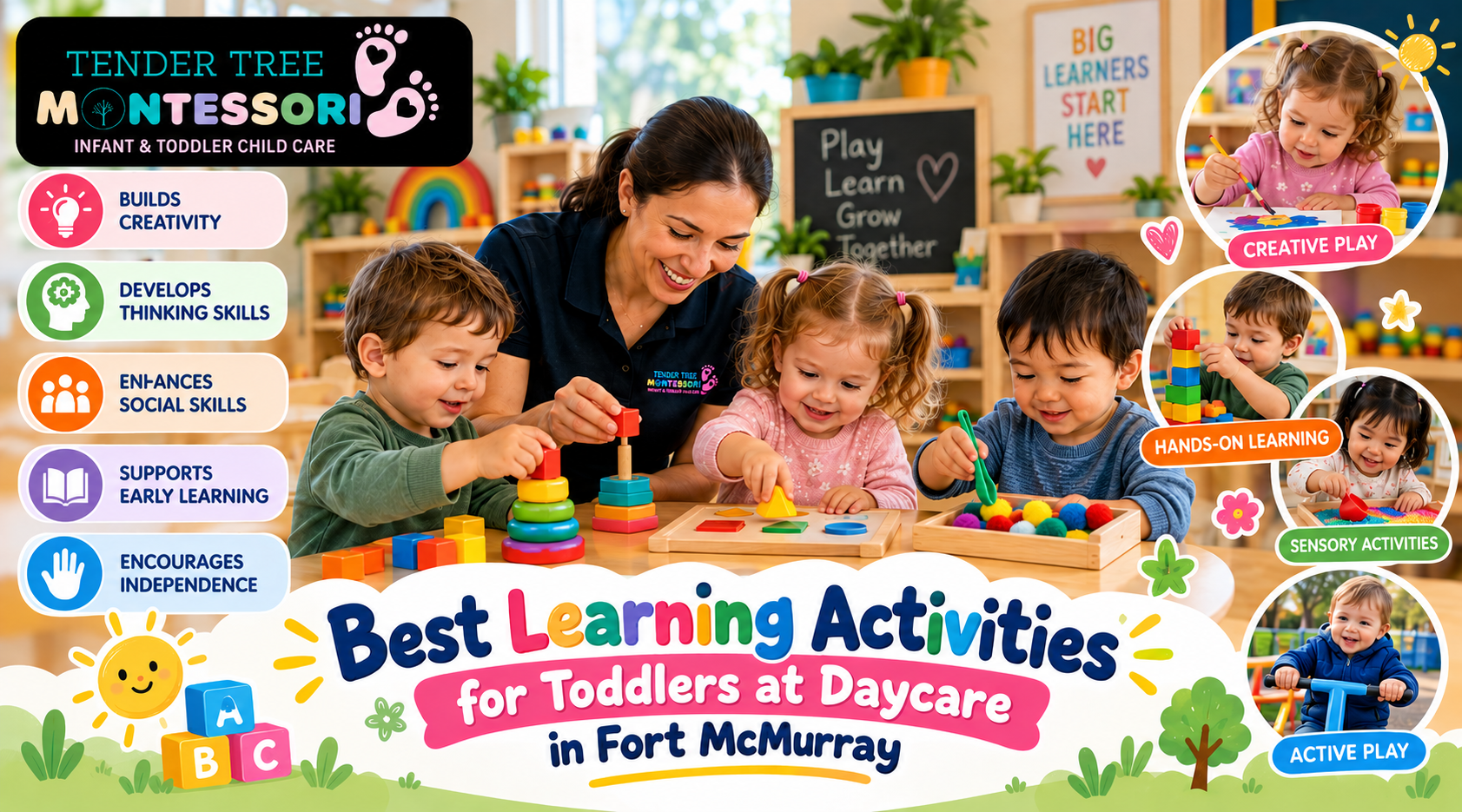
Best Learning Activities for Toddlers at Daycare in Fort McMurray
Best Learning Activities for Toddlers at Daycare in Fort McMurray
Toddlers are naturally curious. They learn by touching objects, listening to sounds, watching others, moving around, and trying new things. Everyday experiences can become valuable learning opportunities when adults provide safe spaces, appropriate materials, and gentle guidance.
For families searching for Toddler Daycare Fort McMurray, choosing a program that encourages active learning is an important step. Parents want more than supervision. They want an environment where their children can develop communication skills, build relationships, strengthen coordination, and explore their interests.
Quality toddler childcare combines nurturing care with activities suited to children’s ages and developmental stages. These activities do not need to be complicated. Stacking blocks, looking at picture books, singing songs, and playing with water under close supervision can all encourage learning.
Tender Tree Montessori is a childcare option for families exploring early learning in Fort McMurray. Understanding which activities support toddler development can help parents ask better questions and choose a program that fits their child’s needs.
1. Sensory Play for Curiosity and Exploration
Sensory play gives toddlers opportunities to explore different textures, colours, shapes, sounds, and materials. It encourages curiosity and helps children learn through direct experience.
What Sensory Activities Can Toddlers Try?
Age-appropriate sensory activities may include:
- Exploring large, safe textured objects.
- Touching fabric, soft sponges, or textured boards.
- Matching objects by colour or shape.
- Listening to gentle musical instruments.
- Exploring water with cups and large containers under continuous adult supervision.
Educators should select materials according to each child’s age and abilities. Small objects that could cause choking, unsafe substances, and items with sharp edges should be avoided.
How Sensory Play Supports Development
Sensory activities encourage children to observe, compare, reach, grasp, and describe what they experience. For example, an educator might introduce words such as soft, rough, wet, or dry while a child explores different materials.
These simple interactions connect physical exploration with language development. They also encourage children to focus, make choices, and experiment safely.
For parents comparing Toddler Childcare Fort McMurray options, ask how sensory activities are planned, supervised, and adapted to different developmental stages.
2. Storytelling and Picture Books for Language Development
Books help toddlers become familiar with words, sounds, pictures, and the rhythm of language. Reading together also creates opportunities for warm, responsive interactions with caregivers.
Make Storytime Interactive
Educators can choose books with colourful illustrations, familiar objects, animals, and simple storylines. Instead of reading every word, they can point to pictures and ask questions such as, “Where is the dog?” or “What sound does the cow make?”
Toddlers may respond by pointing, making sounds, using words, or turning pages. Each response creates an opportunity to practise communication.
Encourage Early Communication
Repeated stories help children recognise familiar words and anticipate what comes next. Songs, rhymes, finger plays, and simple conversations provide additional opportunities to listen and respond.
Educators should give toddlers enough time to communicate without pressuring them to speak. They can model words, acknowledge gestures, and expand on what a child says.
For example, if a child says “ball,” the educator might respond, “Yes, a big red ball.” This approach introduces new language in a natural context.
Expert insight: The American Academy of Pediatrics recommends shared reading from infancy because it supports early language development and strengthens relationships between children and caregivers.
3. Building Blocks and Simple Puzzles for Problem-Solving
Building blocks and age-appropriate puzzles help toddlers experiment, make decisions, and discover how objects fit together.
Develop Coordination and Spatial Awareness
Stacking large blocks encourages toddlers to use their hands and eyes together. They can experiment with balance, height, size, and shape.
When a tower falls, children have another opportunity to try a different arrangement. With patient guidance, they begin to understand that actions can produce different results.
Introduce Early Thinking Skills
Simple inset puzzles and shape sorters encourage children to compare objects and test solutions. Educators can ask questions such as, “Which shape fits here?” or “What happens if we add another block?”
The goal is exploration rather than getting every answer right. Adults should offer encouragement while allowing children to attempt tasks independently.
These toddler learning activities can help develop persistence, attention, hand control, and early reasoning skills.
4. Music, Singing, and Movement Activities
Music makes learning engaging by combining listening, movement, repetition, and social interaction. Toddlers can participate even before they understand all the words in a song.
Use Songs to Build Language Skills
Simple songs, rhymes, and repeated phrases expose children to new vocabulary and sound patterns. Songs involving body parts, animals, or everyday routines can also help toddlers connect words with actions.
Educators can use familiar songs during transitions, such as preparing to tidy toys or gather for a meal.
Encourage Gross Motor Development
Movement activities help children practise balance, coordination, and body awareness. Depending on their abilities, toddlers might march, clap, sway, dance, or follow simple movement instructions.
Activities should take place in a clear, age-appropriate space with close supervision. Educators can adjust the pace and movements to suit each child’s abilities.
Music and movement also provide ways for children to express excitement, participate with peers, and build confidence in group settings.
5. Art and Creative Activities for Self-Expression
Creative activities allow toddlers to explore colours, shapes, materials, and simple ways to express ideas. The emphasis should be on the experience, not on producing a perfect picture.
Introduce Safe Art Materials
Suitable activities may include scribbling with age-appropriate crayons, painting with child-safe materials, making marks with large brushes, or exploring collage materials selected for the child’s age.
Educators should supervise closely, follow product safety instructions, and avoid materials that create choking or ingestion risks.
Celebrate Individual Creativity
Toddlers may use colours unpredictably, repeat the same movement, or lose interest quickly. These behaviours are part of exploration.
Rather than correcting every mark, educators can describe what the child is doing: “You made long blue lines” or “You pressed the sponge onto the paper.”
This language encourages observation and communication while respecting each child’s choices.
Creative activities also help toddlers practise hand movements and make decisions. Children should have opportunities to participate at their own pace without pressure to copy a particular result.
6. Pretend Play and Everyday Life Activities
Pretend play allows toddlers to explore familiar experiences. Playing with toy food, dolls, toy telephones, or age-appropriate household play items can help them practise communication and imagination.
Create Opportunities for Role-Play
An educator might set up a simple pretend kitchen or encourage children to care for a doll. These activities introduce familiar actions such as feeding, washing, preparing food, and helping others.
Children may imitate what they see at home or create their own versions of everyday events.
Encourage Independence Through Simple Tasks
Toddlers can also participate in small, supervised daily activities, such as placing toys in a basket, carrying a lightweight item, or helping tidy a play area.
These experiences introduce responsibility and routine while allowing children to practise movement and follow simple instructions.
Educators should offer assistance when needed and recognise effort rather than expecting toddlers to complete tasks perfectly.
7. Outdoor Play and Nature Exploration
Outdoor play gives toddlers opportunities to move, observe their surroundings, and experience the natural world. When weather and conditions allow, outdoor activities can become an important part of a balanced childcare routine.
Encourage Active Exploration
Age-appropriate outdoor activities may include walking on safe paths, observing leaves, noticing birds, playing with large outdoor toys, and exploring natural textures under supervision.
Educators can introduce simple concepts by asking children to notice colours, shapes, sounds, and changes in their surroundings.
Adapt Outdoor Activities to Fort McMurray Weather
Fort McMurray experiences long, cold winters, so childcare providers need clear procedures for outdoor activities during different seasons.
Parents should ask how educators assess weather conditions, choose suitable clothing, supervise outdoor play, and decide when activities should move indoors. During unsuitable weather, indoor movement games, obstacle courses using safe equipment, and nature-themed activities can help children remain active.
Outdoor play should always match the child’s developmental abilities and the conditions. Warm clothing, appropriate footwear, close supervision, and regular checks for comfort are especially important during winter.
For families comparing Toddler Daycare Fort McMurray programs, ask how the centre balances outdoor experiences with indoor activities throughout the year.
8. Sorting, Matching, and Early Mathematics
Toddlers can begin exploring early mathematical ideas through ordinary play. They do not need worksheets or formal lessons to become familiar with numbers, shapes, sizes, and patterns.
Introduce Simple Sorting Activities
Educators can invite children to group large objects by colour, match identical pictures, or place similar shapes together. Activities should use safe materials suitable for each child’s age.
These experiences encourage children to notice similarities and differences.
Explore Counting and Patterns Naturally
Counting can become part of everyday routines. An educator might count blocks while stacking them, name the number of steps taken, or count a few toys during cleanup.
Toddlers may not understand number concepts immediately, but hearing repeated number words in meaningful situations helps introduce early mathematical language.
Activities should remain playful and flexible. Educators can simplify tasks for younger toddlers and introduce additional challenges when children show interest.
9. Social Games That Build Emotional Skills
Toddlers are learning how to recognise feelings, interact with others, and manage frustration. Guided social activities provide opportunities to practise these emerging skills.
Teach Turn-Taking and Cooperation
Simple ball-rolling games, group songs, and shared building activities can introduce turn-taking. Educators can model phrases such as “My turn” and “Your turn” while helping children participate.
Toddlers still need considerable adult support. Sharing and waiting are developing skills, not behaviours that every child will master at the same age.
Help Children Recognise Feelings
Picture books, facial expressions, and everyday conversations can help children begin to recognise emotions such as happiness, sadness, anger, and surprise.
When a child becomes upset, a calm educator can name the feeling, offer reassurance, and guide the child toward an appropriate response.
These interactions support emotional development and help children gradually learn ways to communicate their needs.
Quality Toddler Childcare Fort McMurray programs should provide opportunities for social learning while respecting individual differences in temperament, communication, and development.
10. How Educators Can Make Learning Activities More Effective
The value of a toddler activity depends not only on the materials but also on how adults introduce and support it.
Follow Each Child’s Developmental Stage
Toddlers develop at different rates. One child may enjoy naming pictures, while another may prefer movement or hands-on exploration.
Educators should select activities that match children’s abilities, interests, and emerging skills. They should also provide additional support when an activity becomes frustrating or unsafe.
Balance Structure With Free Play
A thoughtful daycare schedule includes guided activities as well as time for children to explore independently.
Short activities often work better than long sessions that require toddlers to sit still. Educators can follow children’s interests, introduce new materials, and allow breaks when attention shifts.
Communicate With Parents
Parents know their children’s routines, preferences, and experiences outside daycare. Sharing this information can help educators make activities more meaningful.
For example, a child who enjoys animals at home might become more interested in picture books, animal sounds, or animal-themed puzzles.
Local Relevance: Choosing Toddler Childcare in Fort McMurray
Finding suitable childcare in Fort McMurray involves considering both developmental quality and everyday practical needs. Families may need to balance work schedules, transportation, seasonal weather, and their child’s individual care requirements.
When visiting a childcare provider, consider the following factors:
- Program suitability: Confirm that the centre accepts your child’s age group and offers activities appropriate for toddlers.
- Safety and supervision: Ask about supervision, hygiene, emergency procedures, and age-appropriate learning materials.
- Daily routines: Understand how the program balances meals, rest, play, and learning.
- Winter planning: Ask about outdoor play policies, cold-weather clothing, and indoor alternatives.
- Family communication: Find out how educators share updates and discuss developmental observations.
- Availability and fees: Confirm current enrolment availability, operating hours, costs, and applicable financial assistance.
Families researching the Best Toddler Daycare in Fort McMurray should also verify the provider’s licensing status and ask about educator qualifications.
Tender Tree Montessori is an option for families exploring infant and toddler childcare in Fort McMurray. Contact the centre directly to confirm current program details, age eligibility, and enrolment availability before making a decision.
Frequently Asked Questions
1. What Are the Best Learning Activities for Toddlers at Daycare?
The best learning activities for toddlers combine sensory exploration, picture books, building blocks, music, movement, creative play, and simple social games. These activities support communication, coordination, curiosity, and early problem-solving. Educators should adapt each activity to the child’s age, interests, abilities, and need for supervision.
2. Why Are Play-Based Activities Important in Toddler Daycare?
Play-based activities help toddlers learn by exploring objects, practising new movements, listening to language, and interacting with others. Play also gives children opportunities to make choices and solve simple problems. A supportive educator can extend this learning through conversation, encouragement, and age-appropriate challenges.
3. How Does Toddler Daycare in Fort McMurray Support Child Development?
Toddler daycare in Fort McMurray can support development through supervised play, language activities, social interaction, movement, and consistent routines. These experiences encourage emerging communication, coordination, independence, and emotional skills. Parents should choose a program that adapts activities to each child’s developmental stage and individual needs.
4. When Should Toddlers Start Participating in Learning Activities?
Toddlers can participate in simple learning activities as soon as they show interest and are developmentally ready. Activities should remain short, playful, and age-appropriate. Caregivers can introduce picture books, songs, sensory exploration, and movement while allowing children to take breaks and explore at their own pace.
5. How Can Parents Choose the Best Toddler Daycare in Fort McMurray?
Parents can compare childcare centres by reviewing licensing, staff qualifications, supervision, daily activities, cleanliness, communication, fees, and operating hours. Visiting a centre and asking about toddler development can help families assess suitability. The right program should provide safe, responsive care that fits the child’s needs and family routine.
Conclusion
The best toddler learning activities turn everyday experiences into opportunities for discovery. Sensory play, storytelling, building blocks, music, creative expression, outdoor exploration, and social games can all support early development when adults provide safe materials and responsive guidance.
For families exploring Toddler Daycare Fort McMurray options, look for a childcare environment that balances learning, play, rest, movement, and emotional support. Strong communication between educators and parents can further help children feel secure and make progress at their own pace.
Tender Tree Montessori welcomes enquiries from families exploring childcare options in Fort McMurray. Contact the centre to discuss its current toddler programs, daily learning activities, enrolment availability, and childcare arrangements.
Ready to explore toddler childcare options for your family?
Contact Tender Tree Montessori at +1 (780) 381-5358 to learn more and take the next step toward supporting your child’s early learning journey.