


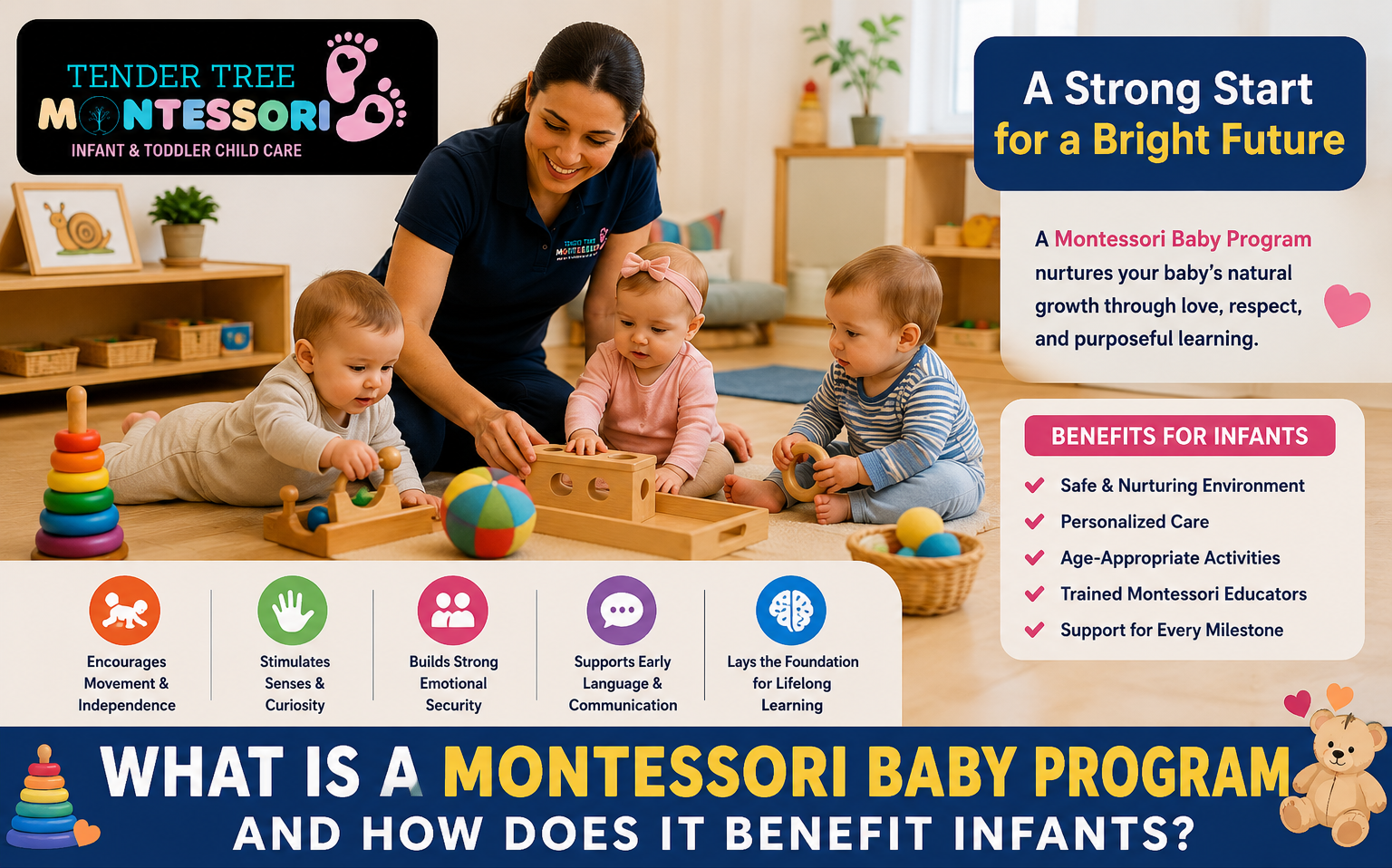
What Is a Montessori Baby Program and How Does It Benefit Infants?
What Is a Montessori Baby Program and How Does It Benefit Infants?
The first years of life are a period of rapid development. Babies learn about their environment through movement, touch, sounds, faces, objects, and relationships. Every interaction can provide an opportunity to discover something new.
This is why the environment surrounding an infant matters.
A Montessori Baby Program is designed around the idea that even very young children are active participants in their own development. Rather than treating babies as passive recipients of care, Montessori environments give them safe opportunities to move, observe, explore, and gradually develop independence.
For parents researching infant childcare, this approach can raise an important question: What makes Montessori different from traditional infant daycare, and how can it benefit a baby?
The answer involves much more than Montessori materials. A quality infant program combines a prepared environment, respectful caregiving, age-appropriate activities, predictable routines, freedom of movement, and close observation of each child’s individual development.
At Tender Tree Montessori in Fort McMurray, families can explore an infant and toddler childcare environment designed around these principles.
What Is a Montessori Baby Program?
A Montessori Program for Babies is an early childhood environment adapted specifically for infants. It applies Montessori principles while recognizing that babies have different developmental needs from preschool-aged children.
The goal is not to make babies complete academic exercises.
Instead, educators create an environment where infants can safely develop movement, coordination, communication, concentration, sensory awareness, and independence.
A Prepared Environment
The Montessori approach uses a carefully prepared environment. For infants, this means furniture, materials, floor spaces, and activities should be safe, accessible, simple, and appropriate for their developmental stage.
An infant may have opportunities to:
- Move freely in a safe area.
- Reach for appropriate objects.
- Explore different textures.
- Observe their surroundings.
- Practice grasping and releasing objects.
- Listen to songs and conversations.
- Participate in simple daily routines.
- Rest and sleep according to their individual needs.
The environment should support exploration without overwhelming the child with too many distractions.
The Adult’s Role
Montessori educators observe children carefully. They introduce activities when appropriate and allow children time to explore.
The educator does not need to direct every moment.
Instead, the adult provides a secure foundation while giving the baby opportunities to discover.
This balance between support and independence is one of the central features of Montessori infant care.
How Montessori Supports Infant Development
Infants develop across several connected areas. Physical movement, language, social relationships, sensory exploration, and cognitive development influence one another.
A well-designed Montessori Infant Program supports these areas through everyday experiences.
1. Encourages Freedom of Movement
Movement is fundamental during infancy.
Babies gradually develop skills such as lifting their heads, rolling, sitting, crawling, standing, reaching, grasping, and eventually walking.
A Montessori environment can provide safe floor space that allows infants to practice these movements naturally.
Rather than restricting babies unnecessarily, educators can create an environment where movement is encouraged while maintaining appropriate safety.
Why Movement Matters
Physical movement helps babies understand their bodies and surroundings.
Reaching for an object, crawling toward a toy, or pulling up to stand involves coordination, balance, spatial awareness, and concentration.
These everyday experiences are important parts of early development.
2. Builds Sensory Awareness
Babies learn about their world through their senses.
They look at objects, listen to voices, touch surfaces, smell familiar environments, and explore safe objects with their hands and mouths.
A Montessori environment can provide carefully selected materials with differences in:
- Texture
- Shape
- Size
- Weight
- Colour
- Sound
For example, an infant may explore a soft fabric, a wooden object, or a simple grasping material under appropriate supervision.
Sensory Learning Is Active Learning
Sensory activities allow babies to make observations.
A baby may discover that one object feels soft while another feels smooth. They may notice that shaking an object creates a sound.
These simple discoveries help build early cognitive connections.
3. Supports Early Language Development
Babies begin developing communication skills long before they speak their first words.
They listen to voices, observe facial expressions, respond to sounds, and gradually learn that communication has meaning.
A Montessori infant environment can provide rich opportunities for language through:
- Conversations
- Songs
- Nursery rhymes
- Storytelling
- Naming objects
- Responsive interactions
- Everyday routines
Educators can talk to babies about what they are doing.
For example:
“I’m going to pick you up.”
“Here is your bottle.”
“Let’s put your sweater on.”
These simple conversations expose babies to language in meaningful contexts.
Responsive Communication Matters
When adults respond consistently to a baby’s sounds, gestures, facial expressions, and attempts to communicate, the child learns that communication is a two-way process.
Early language exposure provides an important foundation for later vocabulary and communication.
Research from the National Center for Education Statistics and other early childhood organizations emphasizes the importance of early language experiences for children’s development.
4. Develops Early Independence
Independence may seem like a goal for older children, but it begins during infancy.
A baby reaches toward an object. They try to hold it. They attempt to move toward something interesting.
Each small attempt is an opportunity to practice self-directed action.
A Montessori Baby Program supports this process by making appropriate materials accessible and allowing children time to try things independently.
Small Choices Matter
As babies grow, educators can provide limited, age-appropriate choices.
For example, an infant may be offered two suitable objects to explore.
These small experiences can help children develop confidence in their ability to interact with their environment.
Independence does not mean leaving a baby without support. It means providing appropriate opportunities while a caring adult remains available.
5. Strengthens Concentration
Babies have shorter attention spans than older children, but they can still become deeply interested in an activity.
An infant may spend several minutes examining an object, moving it, turning it, or listening to its sound.
Montessori environments try to respect these moments of concentration.
Educators avoid unnecessary interruptions when a child is safely engaged.
Repetition Is Valuable
A baby may repeat the same action many times.
They may drop an object, pick it up, and drop it again.
From an adult’s perspective, this can look repetitive. For a baby, however, it can be an important experiment.
The child is discovering cause and effect.
Repetition allows babies to practice skills and understand how their actions affect the environment.
6. Creates Predictable Routines
Babies benefit from consistent routines.
Regular patterns around feeding, sleeping, changing, play, and transitions can help infants understand what to expect.
A Montessori childcare environment can use predictable routines while still responding to individual needs.
Routines Can Become Learning Opportunities
Daily care activities can support development.
For example, during dressing, an educator can talk to the baby about clothing. During mealtime, the educator can name foods and utensils.
These ordinary moments can support:
- Language development
- Social connection
- Sensory awareness
- Sequencing
- Trust
- Emerging independence
Care and learning do not need to be separate activities.
7. Supports Emotional Security
Infants need responsive relationships with trusted adults.
A nurturing Montessori Childcare environment should provide consistent care, warm interactions, and appropriate responses to children’s needs.
When babies receive responsive care, they can gradually develop a sense of trust and security.
Observation Helps Educators Respond
Montessori educators emphasize observation.
They watch how babies move, communicate, interact, and respond to different experiences.
This information can help educators adjust the environment and activities to suit individual developmental needs.
Every baby develops differently. A strong infant program recognizes this difference.
Montessori Materials for Babies
People often associate Montessori with wooden learning materials, but the Montessori approach is not simply about buying special toys.
The environment and how adults interact with children are equally important.
Appropriate infant materials may include:
Grasping Materials
Simple objects can encourage reaching, holding, transferring, and releasing.
Movement Materials
Safe movement spaces can support crawling, pulling up, standing, and walking as children develop.
Sensory Materials
Objects with different textures, sounds, shapes, or weights can encourage exploration.
Books
Simple books with clear images can support visual attention and early language.
Practical-Life Experiences
As babies become more capable, simple participation in routines can encourage emerging independence.
Materials should always be age-appropriate and used with proper supervision.
Montessori Baby Program vs. Traditional Infant Daycare
Both Montessori and traditional childcare programs can provide safe, nurturing care. The main difference is often the educational philosophy and organization of the environment.
A Montessori infant program typically emphasizes:
| Montessori Infant Approach | General Infant Care |
| Prepared environment | Care environment |
| Freedom of safe movement | Supervised movement |
| Observation-based activities | Routine-based activities |
| Hands-on exploration | Play and exploration |
| Emerging independence | Adult-supported care |
| Individual developmental pace | Group routines |
| Purposeful materials | Variety of toys and materials |
The quality of a program depends on many factors, including educator training, safety, relationships, supervision, communication, and the individual needs of children.
Parents should evaluate the actual program rather than relying only on its label.
What Parents Should Look for in Montessori Infant Childcare
When comparing Montessori Daycare options, parents should ask practical questions.
Is the Environment Safe?
Check whether the space is clean, secure, well maintained, and designed for infants.
Ask about:
- Safe sleep practices
- Supervision
- Emergency procedures
- Hygiene
- Food and feeding procedures
- Indoor and outdoor safety
Are Educators Responsive?
Observe how educators talk to and interact with babies.
Do they respond calmly?
Do they notice children’s cues?
Do they communicate warmly?
These interactions matter.
Does the Program Respect Individual Development?
Babies reach milestones at different times.
A quality program should observe individual development rather than expecting every child to progress at exactly the same pace.
How Does the Centre Communicate With Parents?
Parents should understand how the centre shares information about:
- Feeding
- Sleep
- Diapering
- Activities
- Development
- Daily routines
- Concerns or changes
Strong communication helps families remain involved in their child’s care.
Montessori Early Learning in Fort McMurray
Families in Fort McMurray looking for infant childcare may have different schedules, priorities, and expectations.
Some parents want a nurturing environment for their baby’s first group-care experience. Others are specifically interested in Montessori education and want to introduce its principles during infancy.
Montessori Early Learning can provide an opportunity to combine responsive care with purposeful exploration.
For families researching Montessori Childcare in Fort McMurray, visiting a centre can provide valuable information that cannot be found on a website alone.
During a visit, parents can observe the classroom, ask about daily routines, meet educators, and learn how the program responds to infants’ individual needs.
Tender Tree Montessori offers infant and toddler childcare in Fort McMurray with a Montessori-inspired approach focused on nurturing development, exploration, independence, and meaningful relationships.
Frequently Asked Questions
What is a Montessori Baby Program?
A Montessori Baby Program is an infant care and early learning environment designed around Montessori principles. It provides safe movement, sensory exploration, responsive caregiving, age-appropriate materials, and opportunities for emerging independence. The goal is to support natural development rather than push formal academic learning during infancy.
Why is Montessori beneficial for infants?
Montessori can benefit infants by providing a calm, prepared environment that encourages movement, sensory exploration, concentration, communication, and emerging independence. Educators observe each child and adapt activities to developmental needs. Consistent routines and responsive interactions can also support emotional security and healthy early relationships.
How does Montessori help babies become independent?
Montessori supports infant independence by giving babies safe opportunities to move, reach, grasp, explore, and make simple choices. Educators provide assistance when needed but avoid unnecessarily interrupting a child’s efforts. As children develop, they can gradually participate in simple routines and activities that encourage confidence and self-help skills.
When can a baby start a Montessori program?
A baby can begin a Montessori infant program when the program accepts children within the appropriate age range and the family feels comfortable with the environment. The specific starting age varies by childcare provider. Parents should discuss feeding, sleep, developmental needs, routines, and transition plans before enrollment.
Who is a Montessori Infant Program suitable for?
A Montessori Infant Program can suit families who value hands-on exploration, responsive caregiving, independence, predictable routines, and child-centered learning. It may be especially appealing to parents who want Montessori principles introduced from infancy. However, families should visit the centre and consider whether its environment and care approach fit their child’s needs.
Conclusion
Infancy is not a waiting period before learning begins. Babies are learning every day through movement, relationships, sensory experiences, sounds, observation, and exploration.
A thoughtfully designed Montessori Baby Program recognizes this natural development and creates an environment where infants can safely participate in their own learning.
The Montessori approach emphasizes respectful caregiving, freedom of movement, purposeful materials, observation, repetition, and emerging independence. These principles can support physical, cognitive, language, social, and emotional development.
For families searching for a Montessori Program for Babies, Montessori Infant Program, Montessori Daycare, Montessori Childcare, or Montessori Early Learning option in Fort McMurray, it is important to choose an environment that combines educational philosophy with safe, responsive, high-quality care.
Tender Tree Montessori provides an infant and toddler childcare environment in Fort McMurray designed to support children’s early development through meaningful experiences and respectful care.
Contact Tender Tree Montessori at +1 (780) 381-5358 to learn more about the Montessori Baby Program and discover an early learning environment where your baby can explore, develop, and grow with confidence.