


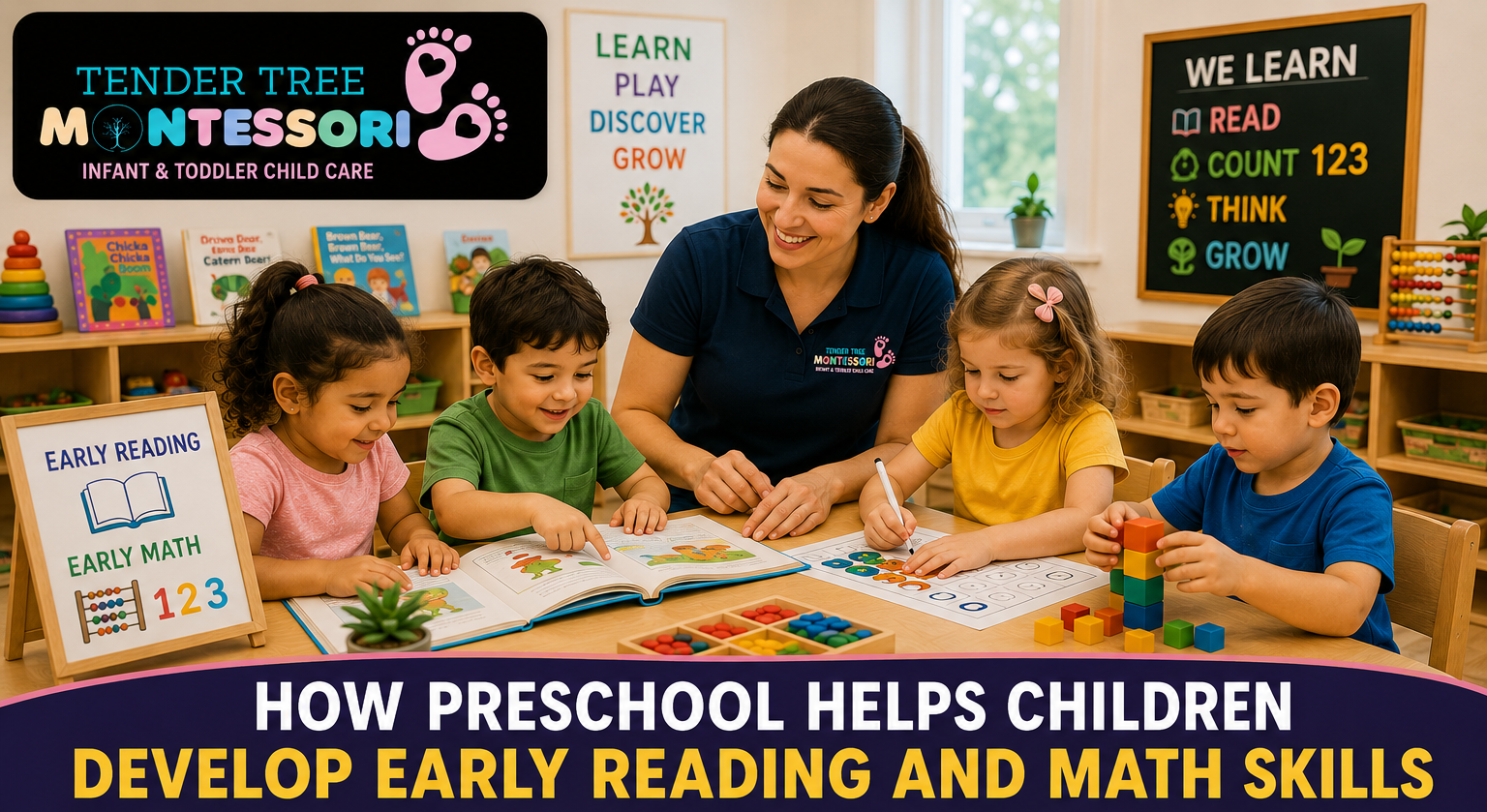
How Preschool Helps Children Develop Early Reading and Math Skills
How Preschool Helps Children Develop Early Reading and Math Skills
The preschool years are an important period for building the foundation children will use when they begin formal school. During these years, children become increasingly interested in letters, stories, numbers, shapes, patterns, and the world around them.
However, young children do not need hours of worksheets to prepare for kindergarten. They learn best when they can explore, ask questions, move, talk, play, and interact with supportive adults and other children.
That is why high-quality Preschool Programs Fort McMurray can play an important role in early childhood development. A thoughtfully designed preschool environment introduces academic concepts through activities that match a child’s age and developmental stage.
At Tender Tree Montessori, children can experience learning through purposeful activities that encourage independence, curiosity, concentration, language development, and early mathematical thinking.
How Preschool Supports Early Reading Skills
Early reading development begins long before a child reads an entire sentence independently. Preschool provides opportunities to develop the language and literacy skills that eventually support confident reading.
1. Building Vocabulary Through Conversation
Children learn new words through meaningful conversations. Teachers can introduce vocabulary during stories, classroom activities, songs, nature exploration, and everyday routines.
For example, a teacher might introduce words such as smooth, rough, large, tiny, heavy, or light while children explore objects.
A larger vocabulary helps children understand stories and communicate their own ideas. According to early childhood research, oral language and vocabulary are important foundations for later literacy development.
2. Developing Phonological Awareness
Phonological awareness is the ability to notice and work with sounds in spoken language. It can include recognizing rhyming words, identifying beginning sounds, clapping syllables, and noticing differences between words.
Preschool teachers can develop these skills through:
- Rhyming games
- Songs and nursery rhymes
- Sound-matching activities
- Syllable clapping
- Beginning-sound games
- Storytelling
- Repetition and word play
These activities help children pay attention to the sounds that make up spoken language.
3. Introducing Letters and Sounds
Preschool children can gradually become familiar with letters and the sounds associated with them. Teachers may use movable letters, picture cards, sound games, books, and other hands-on materials.
The goal is not simply to make children memorize the alphabet. Instead, children begin connecting visual symbols with sounds and language.
This connection becomes increasingly important as children move toward independent reading.
4. Encouraging a Love of Books
Regular exposure to books helps children understand how stories work and how printed language communicates meaning.
Teachers can read aloud while children:
- Listen to stories
- Look at illustrations
- Predict what might happen
- Answer questions
- Retell parts of a story
- Discuss characters and events
- Handle books appropriately
Shared reading also introduces concepts such as reading from left to right, recognizing the front and back of a book, and understanding that printed words carry meaning.
5. Supporting Early Writing
Writing and reading develop together. Preschool activities such as drawing, tracing, painting, using sandpaper letters, and practicing fine-motor movements can prepare children for writing.
Children may first create marks and drawings before gradually developing more controlled letter formation.
Fine-motor activities are particularly useful because children need hand strength, coordination, and control to use pencils and other writing tools effectively.
How Preschool Builds Early Math Skills
Early mathematics is not limited to memorizing numbers. Young children develop mathematical thinking when they compare objects, recognize patterns, organize materials, measure, count, and solve simple problems.
A strong Early Learning Centre Fort McMurray can incorporate these concepts into everyday classroom experiences.
1. Learning to Count
Counting is one of the first mathematical skills children develop.
Preschool teachers can make counting practical by asking children to count:
- Blocks
- Beads
- Toys
- Steps
- Classroom objects
- Pieces of fruit
- Children in a group
Hands-on counting helps children connect number words with actual quantities.
2. Understanding Numbers and Quantity
Knowing the sequence of numbers is different from understanding what those numbers represent.
For example, a child may recite “one, two, three, four” but still need practice connecting the word four with four actual objects.
Preschool activities can help children understand quantity by allowing them to physically move, group, match, and count objects.
3. Sorting and Classifying
Sorting is an important early mathematical skill.
Children can sort objects according to:
- Colour
- Shape
- Size
- Texture
- Function
- Number of sides
Sorting teaches children to observe characteristics and organize information.
These skills later support more advanced mathematical reasoning.
4. Recognizing Patterns
Patterns appear everywhere in a child’s environment. Clothing, music, nature, blocks, and classroom materials can all provide opportunities to identify patterns.
For example:
Red – blue – red – blue
A teacher can ask children what comes next.
Pattern activities develop observation, prediction, sequencing, and logical thinking. These abilities provide useful preparation for later mathematics.
5. Learning Shapes and Spatial Concepts
Preschool children also begin learning about shapes and spatial relationships.
They may explore concepts such as:
- Circle
- Square
- Triangle
- Rectangle
- Inside and outside
- Above and below
- Near and far
- In front of and behind
Building with blocks and completing puzzles can strengthen spatial awareness while encouraging problem-solving.
6. Measuring and Comparing
Children naturally compare objects. Preschool teachers can turn these everyday observations into learning opportunities.
Questions might include:
- Which object is longer?
- Which container holds more?
- Which tower is taller?
- Which item is heavier?
- Which group has fewer objects?
These experiences introduce children to measurement and comparison without requiring complicated formulas.
Why Play-Based Learning Matters
Play is one of the most effective ways young children explore ideas. A child building a tower is not simply playing with blocks. They may also be exploring balance, size, shapes, quantity, measurement, and spatial relationships.
Similarly, a child pretending to run a store may practice counting, vocabulary, communication, and social skills.
High-quality Child Care Fort McMurray programs can intentionally create environments where play supports developmental goals.
Guided Play Combines Fun With Purpose
Guided play gives children freedom to explore while teachers provide direction when appropriate.
For example, a teacher may observe children building with blocks and introduce a question such as:
“Can you make another tower with the same number of blocks?”
The children remain engaged in play while also practicing counting and comparison.
The Montessori Approach to Early Literacy and Math
Montessori education emphasizes hands-on learning, independence, repetition, concentration, and carefully prepared learning environments.
Many Montessori materials are designed to help children understand concepts through direct experience.
Practical Activities Build Mathematical Thinking
Montessori classrooms often use concrete materials that allow children to physically explore quantities, sequences, sizes, and relationships.
Instead of only hearing about a mathematical concept, children can manipulate materials and observe how they work.
This concrete experience can help make abstract ideas easier to understand as children mature.
Hands-On Language Activities
Montessori language materials can also introduce children to letters, sounds, vocabulary, and early writing.
Activities may involve touching, seeing, hearing, and manipulating materials. Using multiple senses can make learning more engaging and memorable.
The Montessori approach also encourages children to work at an appropriate pace. Some children may spend more time practicing a particular skill before moving to the next challenge.
Social Skills Also Support Academic Learning
Reading and math do not develop separately from the rest of a child’s development.
Children need communication, attention, confidence, self-regulation, and cooperation to participate effectively in learning activities.
For example, a child who learns to wait for a turn can participate more successfully in a group counting activity. A child who can communicate questions may seek help when encountering a new word.
Therefore, strong Preschool Programs Fort McMurray should support the whole child rather than focus only on academic skills.
What Parents Should Look for in Preschool Programs
When comparing Preschool Fort McMurray options, parents should consider more than the classroom appearance.
Look for programs that provide:
Age-Appropriate Learning
Activities should match children’s developmental abilities. Preschool learning should challenge children without creating unnecessary pressure.
Qualified and Caring Educators
Teachers should understand early childhood development and know how to encourage children through different stages of learning.
Language-Rich Environments
Children benefit from frequent conversations, storytelling, songs, books, and opportunities to express themselves.
Hands-On Mathematics
Look for activities involving counting, sorting, shapes, patterns, measurement, and problem-solving.
Opportunities for Independence
Children should have opportunities to make appropriate choices, complete tasks, care for materials, and develop confidence.
Safe and Supportive Classrooms
A positive environment allows children to explore while maintaining appropriate routines, boundaries, and supervision.
Local Relevance: Early Learning in Fort McMurray
Families in Fort McMurray have a variety of childcare and early education needs. Parents may be looking for a program that provides more than supervision during the day.
The right Early Learning Fort McMurray environment can help children develop early academic foundations while also supporting social, emotional, physical, and communication skills.
Local families searching for an Early Learning Centre Fort McMurray can consider how each program approaches literacy, mathematics, independence, classroom routines, and individual learning needs.
For families considering Child Care Fort McMurray, it is also helpful to visit potential centres, ask questions about daily activities, and understand how teachers communicate children’s progress.
Tender Tree Montessori provides an early learning environment designed to encourage children’s natural curiosity and growing independence. Families can explore how the Montessori approach can support early reading, mathematics, practical life skills, and overall development.
Frequently Asked Questions
What reading skills do children learn in preschool?
Preschool children develop foundational reading skills such as vocabulary, listening comprehension, phonological awareness, letter recognition, and understanding how books and print work. They may also begin connecting letters with sounds and practicing early writing. These skills create a foundation for more advanced reading development during kindergarten and the early elementary years.
Why are early math skills important before kindergarten?
Early math skills help children understand quantity, numbers, patterns, shapes, measurement, and relationships. Preschool experiences give children opportunities to practice these concepts through real objects and everyday activities. Strong early mathematical foundations can make it easier for children to engage with more formal mathematics when they enter kindergarten and elementary school.
How does play help children learn reading and math?
Play gives children meaningful opportunities to practice language, counting, sorting, patterns, problem-solving, and communication. For example, building with blocks can develop spatial and mathematical thinking, while pretend play can strengthen vocabulary and storytelling. Guided play combines children’s natural curiosity with purposeful learning opportunities provided by educators.
When should children start learning letters and numbers?
Children begin developing early literacy and mathematical concepts from infancy through everyday interactions. Preschool provides structured opportunities to build these skills at an age-appropriate pace. Children can explore sounds, letters, counting, shapes, and patterns through stories, songs, games, practical activities, and hands-on materials without requiring formal academic pressure.
Who can benefit from Montessori preschool programs?
Montessori preschool programs can benefit children who enjoy hands-on exploration, repetition, independence, and learning through concrete materials. The approach encourages children to develop concentration, practical skills, language, mathematical thinking, and confidence. Families should consider each child’s individual needs and visit programs to determine whether the environment is a good fit.
Conclusion
The preschool years provide an important opportunity to build the foundations for future learning. Early reading develops through conversations, stories, sounds, vocabulary, letters, and writing experiences. Early math grows through counting, sorting, patterns, shapes, measurement, and problem-solving.
The best early learning environments make these experiences meaningful and engaging. Children learn when they can explore, ask questions, practice skills, and receive encouragement from caring educators.
For families searching for Early Learning Fort McMurray, Preschool Fort McMurray, or quality Preschool Programs Fort McMurray, Tender Tree Montessori offers an environment where children can develop academic foundations alongside independence, confidence, communication, and social skills.
If you are looking for a trusted Early Learning Centre Fort McMurray or Child Care Fort McMurray option, contact Tender Tree Montessori at +1 (780) 381-5358 to learn more about the program and discover how your child can begin their learning journey.